rseries
39 TopicsF5OS cloud-init on 21.1 does tenants come with DO and AS3 RPM installed?
Hello Everyone, This great new feature https://techdocs.f5.com/en-us/bigip-21-1-0/big-ip-f5os-cloud-init-support-velos-rseries/cloud-init-support-velos-rseries.html is not very well described. I think F5 making a demo session or a Guide with pictures will be helpful. For example do the F5os Tenants come with RPM AS3 and DO installed by default for this to work ? Other than that it is mentioned that the DO yaml file needs to be hosted on F5OS ? Where exactly ?288Views1like6CommentsF5OS using Ansible Linux Shell with remote users as iCall replacement(works with banner as well).
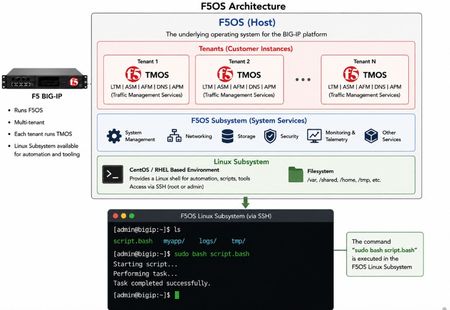
(AI Made picture so don't take it as 100% truth) In F5OS 1.8.0 and up remote users can automatically enter the Linux Shell if they have the correct remote group parameters and if this is system level enabled as shown in https://clouddocs.f5.com/training/community/rseries-training/html/rseries_security.html#superuser-role The superuser role if enabled can still trigger F5OS commands with "f5sh" that is similar to "tmsh" in TMOS and described in https://my.f5.com/manage/s/article/K000148922 . Code version: The code was tested on F5OS 1.8.4 rSeries 5900 Ansible Example without banner: --- - name: Restart docker container hosts: f5os gather_facts: no vars: container_name: tcpdumpd_manager tasks: - name: Restart the specified docker container ansible.builtin.shell: | docker restart {{ container_name }} become: false args: executable: /bin/bash Cronjobs also can be edited through shell Ansible playbook for scheduling transferred scripts. - name: Add cron job ansible.builtin.shell: | (crontab -l 2>/dev/null | grep -Fv '/opt/check_service.sh'; \ echo '*/5 * * * * /opt/check_service.sh') | crontab - become: false args: executable: /bin/bash Great Ansible F5OS automation article with cool examples that even has file transfer for transferring script file to the F5OS: Five Ways to Automate F5OS with Ansible: A Practical Guide | DevCentral Ansible Example with banner: The F5OS ssh banner is inserted between the username and password and that breaks the shell module as I did found out. I suspect that Ansible uses the PEXPECT Python package that spans SSH session and it is similar to TCL EXPECT and most people dealing with iRules will find this interesting. You need to add sudo in-front of each command. - name: Restart container hosts: localhost gather_facts: false tasks: - name: Run docker command ansible.builtin.expect: command: >- ssh -tt -o StrictHostKeyChecking=no -o ConnectTimeout=10 -o ServerAliveInterval=5 -o ServerAliveCountMax=2 {{ ansible_user }}@{{ ansible_host }} responses: '(?i)password:': {{ ansible_pass }} '(?m)\$\s*$': "sudo docker restart {{ container_name }}\nexit\n" timeout: 20 echo: true delegate_to: localhost register: out Also SCP file transfer can be done through the EXPEC module. From Linux bash you can use f5sh to trigger F5OS commands. Examples are f5sh "show interface" and to chain commands f5sh "config; vlan 500; commit; exit" . If you just write f5sh, you will enter the F5os from the Linux. This is like tmsh for TMOS. Summary! This is great feature. TMOS also has cronjobs but after upgrade the cronjob is lost but not on F5OS, this is why icall scripts still are better for TMOS Tenants. iCall has the option to be triggered by logs and that in F5OS will be harder as it will need a bash script that is sitting as a background process as to monitor the logs and a cronjob can check if the script is still running as a device reboot will cause the script to stop running. The script can be transferred and started the way I have shown with RESTCONF REST-API with Ansible/AWX as the best option.164Views2likes1Comment
rSeries: config changes in logs
For F5 rSeries load balancers: - Are all configuration changes (e.g. enabling / disabling nodes; creating / modifying / deleting virtual servers) somehow documented in the F5 device's logs? If yes... - Where may we find those logs? - Is there an quick way to somehow convert those logs into CLI commands that we may run in the CLI of other F5 devices? Our reason for asking the questions above: We are currently working on upgrading the F5 load balancers of our customer, from iSeries, to rSeries. One challenge that we will face is how to completely migrate all of the config from their iSeries to rSeries, noting that they frequently perform configuration changes on their iSeries, practically every day.121Views0likes1CommentF5OS restarting container services through REST API
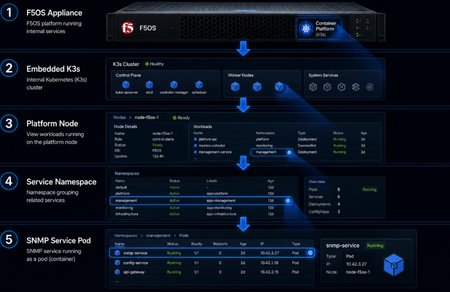
(The Image is made with ChatGPT AI just to highlight the F5OS kubernetes cluster, for exact list of the kubernetes pods see https://my.f5.com/manage/s/article/K000134978) Most of the F5OS services are in docker containers as F5OS is made of kubernetes cluster. If there is a memory or CPU leakage or another issue that needs a container to be restarted then this feature will be helpful. With F5OS 1.8.4 the option to restart those services is available and here is a short demonstration. Code version: The code was tested on F5OS 1.8.4 rSeries 5900 CURL example: (:8888/restconf can be used or /api as I prefer the send one 🙂 ) curl -k -X POST -H'Content-Type: application/yang-data+json' -u <USERNAME>:<PASSWORD> "https://<MANAGEMENT-IP>:8888/restconf/data/openconfig-system:system/f5-system-diagnostics-qkview:diagnostics/f5-system-diagnostics-docker:os-utils/f5-system-diagnostics-docker:docker/f5-system-diagnostics-docker:restart" -d '{ "node" : "platform" , "service" : "snmpd" }' POSTMAN example: Ansible Example: Automating the F5OS token authentication as to not use basic authentication as it is better than sending username and password each time https://my.f5.com/manage/s/article/K000148418 - name: Resart Service ansible.builtin.uri: url: "https://10.10.10.12/api/data/openconfig-system:system/f5-system-diagnostics-qkview:diagnostics/f5-system-diagnostics-docker:os-utils/f5-system-diagnostics-docker:docker/f5-system-diagnostics-docker:restart" method: POST headers: Content-Type: application/yang-data+json X-Auth-Token: "{{ token }}" validate_certs: false status_code: - 200 body_format: json body: node: platform service: snmpd register: primary_key Great Ansible F5OS automation article with cool examples: Five Ways to Automate F5OS with Ansible: A Practical Guide | DevCentral F5OS API reference: https://clouddocs.f5.com/api/rseries-api/F5OS-A-1.8.4-api.html?section=f5-system-diagnostics-docker#operation/data_openconfig_system_system_f5_system_diagnostics_qkview_diagnostics_f5_system_diagnostics_docker_os_utils_f5_system_diagnostics_docker_docker_f5_system_diagnostics_docker_restart_post Github Repo Link: https://github.com/Nikoolayy1/F5OS-API-Ansible/blob/main/README.md Summary! This automation can be used for triggering process/service restart through the API. For example the logs a metrics can be send to a SIEM/SOAR server that then through Automation can trigger the restart. For more complex tasks needing the Linux access the new superuser role could be used https://clouddocs.f5.com/training/community/rseries-training/html/rseries_security.html#superuser-role and Automatons like Ansible playbooks that use the native shell module. There could be 2 ansible playbboks as one uploading a script and other executing or scheduling it through cronjob edition.271Views2likes2Comments
Logical Disk Full to Migrate rSeries
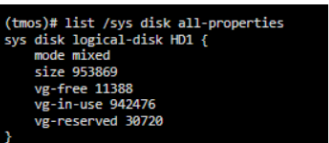
Hello Community I hope You're Well!!! I have in process to migrate services of iSeries platform (i4800) to rSeries(r2800), but i have a question i review the actual configuration of iSeries and i see the resources. I am concerned about the logical disk usage, as, according to the attached image, there is high disk usage in vg-in-use. According to the R2800 datasheet, the hard drive has a capacity of 480 GB M.2. Could this affect the migration, or is any resizing necessary, or can troubleshooting be performed on the current iSeries? Thanks!!!!139Views0likes1CommentClean Installation of F5OS-A on rSeries After Drive Erasure or Console Loss
Article Summary This article provides a step-by-step guide for performing a clean installation of F5OS-A on F5 rSeries appliances using a USB flash drive. It covers prerequisites, console configuration, enabling the front-panel USB port through the Always-On Management (AOM) interface, creating bootable installation media, and completing the installation process. The guide also includes troubleshooting tips, post-installation considerations, and alternative PXE-based installation options for environments where USB usage is restricted.871Views4likes1CommentCPU utilization of F5OS on r2600
We have installed a new r2600 cluster and configured successful SNMP-monitoring. Here I must notice, that the CPU utilization of the F5OS with an average of more than 50% and peaks up to 90% is relatively high. The CPU utilization of the tenant looks fine with an average of around 15%. There is currently no active configuration on it nor any virtual server traffic passing the device. Is this a normal behavior, especially in comparison to the r5600 platform, where the F5OS CPU utilization average is at around 10%? Thank you! Regards, Stefan :)241Views0likes2CommentsF5OS VLAN naming length restrictions
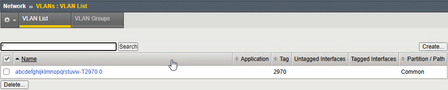
I must notice, that there seems to be a length restriction when creating VLANs on F5OS. I'm allowed to enter long names on F5OS-level without any warnings or errors, but when assigning them to a tenant, the name within the tenant will be truncated if its longer than 31 characters. It looks like this, means there is a suffix in the format of "-T<VLAN-ID>.0" On F5OS-level it looks like this: Is this a normal behavior? Can or will this be fixed? And are there any other such restrictions for other configuration items? For your reference, we are running F5OS 1.8.3 and BIG-IP 17.5.1.3. Thank you! Regards, Stefan :)334Views0likes4CommentsBehavior of masterkey on rSeries
Is there any difference in regards to the usage of the masterkey on rSeries? I mean is this still different/dedicated for the F5OS and all the tenants? Or is there just ONE masterkey, which needs to be adjusted on F5OS level? Reason why I'm asking, I want to load a bigip.conf file from an iSeries on a Tenant of a rSeries. I performed the procedure with f5mku commands to have the same masterkey on the new rSeries Tenant and it will also be displayed correctly. But when I try to load/verify the configuration (load sys config partition { xyz } verify) I still get the error message: Decryption of the field (pvalue) for object (xxx 1 PASSWORD=) failed while loading configuration that is encrypted with a different master key. Is there anything else I should double check? Thank you! Regards, Stefan :)Solved523Views0likes4Comments