announcement
137 TopicsDevCentral MVP Program
Every day, all over the world, smart, passionate people are doing amazing things with their F5 gear and sharing that knowledge with their peers. The DevCentral Community MVP program shines a spotlight on the best, brightest and most active members of our community, and rewards them for their efforts. The DevCentral Community MVP is an annual award given to a select cohort of the best, brightest, and most active members of our community - users who actively improve F5 user communities and the broader tech industry by sharing their technical experience and expertise with others. We like to reward people who help make our technical user communities healthy and a place users want to interact, and would like to say thank-you to you specifically for making our communities a valuable resource for all users. MVPs get a special badge on their profile for the calendar year of their cohort, so users can know at a glance who they are. Among other things, they also get exclusive swag, invitations to technical deep-dive and sneak-preview sessions presented by F5 SMEs, invitations to the MVP Group and are often highlighted in our monthly Featured Member articles. Here's the announcement of the 2023 cohort! To nominate someone who has helped you to be an MVP, click HERE.66KViews6likes1CommentMohamed - July 2026 Featured F5er
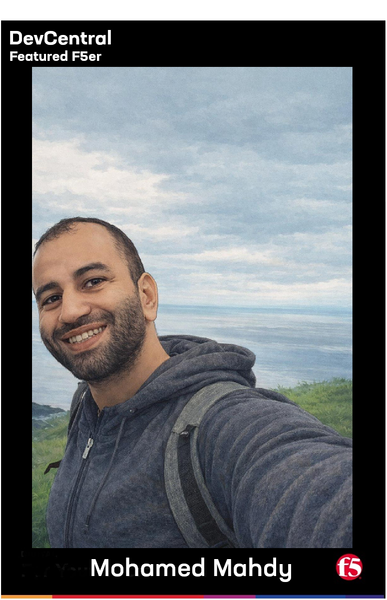
Welcome to our Featured F5er Series. For July we are spotlighting momahdy, an exceptional contributor to our DevCentral community. DevCentral: To start, please introduce yourself and tell our community a little about yourself. What you do and why is it important? Mohamed: Hello everyone! My name is Mohamed Mahdy and I've been with F5 for the last 8 years, 4 of them in Consulting and the past 4 years in Technical Marketing team. Through the 8 years I covered different sectors whether Government, Defense, Services Providers, Financial or Education sectors. Why I got into security in general; I always loved learning everything, and one major part of our work involved understanding every deployment and project, not just the technical elements but the impact it leaves on every person involved. Few seconds delay, a breach or even a complex solution can be the difference between critical systems and efforts being protected or wasted. In addition to the actual work, I really enjoy educating the community because that's how I learn the best; The moment I meet a friend who says that he used any of the articles or any of our conversations and those were helpful, I feel the message is well delivered. Away from Work, I'm leading ISC2 chapter in West Midlands and participating in multiple community activities for security education. DevCentral: As a Principal Technical Marking Engineer at F5, what is your typical workday like? Mohamed: Big part of it connecting with my colleagues in Product team and field team to explore how can we get more end-to-end use cases to the community to help customers get familiar with the use cases and try them out. In some cases we are engaged with our colleagues in the field to help accelerate troubleshooting activities or solutions enhancement. One of the interesting areas of Technical Marketing Engineering team, is that we set at the cross roads between Technical and Business, that allows us to speak both languages and understand both; So, we help getting the end-to-end solutions use cases those actually help our customers and contribute to the field. DevCentral: What do you do to maintain a work life balance? Mohamed: Having great colleagues sometimes make work time feels like home, in addition to this I would say running and family time is what keeps the spark DevCentral: Can you give us a glimpse into your technical expertise? Mohamed: My approach is why not give it a try ? It's not working, let's roll up our sleeves. I started in Service Providers where packet captures solve your most critical issues, moving into F5 I got exposed to everything from L1 up to L7, whether it's a deployment, design or troubleshooting. F5 products are unique, you don't need to know F5 configurations only but also understanding the underlying protocols. DevCentral: What’s the most exciting thing you’re working on right now? Mohamed: Currently I'm focusing on BIG-IP Service Providers technologies and Kubernetes offerings (BNK / CNF / CIS ). Also leading the hybrid integrations with BIG-IP security products in general. I'm working on more articles to introduce those topics in an easy way to our community and make sure we are not lost in the new terms, and we are actually focusing on what works. DevCentral: What has been your most memorable achievement at F5? Mohamed: I would say every time a field colleague mention that any of the labs or articles helped I consider that a memorable moment. The most memorable one would be participating in AppWorld Vegas preparations. Seeing all those technical content in booths and customers talking and asking our SMEs after months of preparation, that was awesome. DevCentral: As an F5er who participates in the DevCentral community how has it helped or influenced your work? Mohamed: DevCentral community was special not just when I joined F5 but even before being part of F5; the ease of discussing solutions, raising queries and talking to peers in different industries in such community spirit really helped. DevCentral: Are there any challenges that community has helped you overcome? If so, what was it and how did community help? (Does not have to be DevCentral related) Mohamed: I would start with iRules, the other one would be learning to find different ways to deliver the information to suite different audiences. DevCentral: What does community mean to you? Mohamed: A group of diverse background persons crowdsourcing their knowledge to get the best outcome, the community acts as incubator for ideas DevCentral: What is your favorite or best piece of advice someone has given you? Mohamed: Security shouldn't be forced; Through my career I found this is the best advice, talking to the business and application teams to first understand their needs and then walk them through how security can be an enabler not a gate keeper proved to be the best approach. DevCentral: If you weren't in your current profession what would be your dream job? Mohamed: I would go for farming, I've been doing random trials here and there to plant mint and other plants, and I would say it's fun and very comforting DevCentral: What are your favorite or go to comfort foods? Mohamed: Yam yam yam! I would go for the Egyptian Koshari DevCentral: Now that we have entered summer, what are your favorite summer activities? Mohamed: I would say if I'm in Egypt, going to the sea at Marsa Matrouh. DevCentral: Lastly, what motivates you? Mohamed: New challenges, problems we need to find solutions for. Connect with Mohamed on LinkedIn Thank you Mohamed for all of your contributions to DevCentral and for being July's Featured F5er!861Views5likes4Comments
Announcing the first F5 NGINX Commercial Long-Term Support release
Today, we’re introducing a major change in how NGINX delivers software to enterprise customers: the first F5 NGINX Commercial Long-Term Support (LTS) release. Due to 2026's intensifying threat landscape, platform teams are under increasing pressure to keep critical infrastructure secure while minimizing operational disruption. Frequent upgrades, short support timelines, and constantly evolving features make that challenge harder than it needs to be. NGINX recognizes this burden. For the first time, NGINX customers can now choose: an annual, feature-frozen release with three years of guaranteed support, or the frequent updates they’ve always relied on to stay at the “cutting edge”. Why we introduced LTS Modern application environments, especially Kubernetes and API-driven platforms, demand both reliability and velocity. Until now, achieving that balance has often required trade-offs; frequent upgrades, shorter support windows, or unclear lifecycle expectations. The new NGINX LTS track eliminates those tradeoffs for production environments that value long-term stability. What is in the first LTS Release The inaugural NGINX LTS release launches with F5 NGINX Plus. F5 NGINX Ingress Controller. This is just the beginning-the LTS program is designed to grow, with more NGINX products joining in 2027. A clear support lifecycle model Each NGINX LTS release is supported for 36 months from General Availability and includes critical and high-security fixes, stability bug fixes, maintained third‑party dependencies, and full technical support. LTS releases are feature-frozen to protect production stability. Two Release Paths Long‑Term Support (LTS) Annual, feature‑frozen releases designed for production environments that demand stability. Each LTS release is supported for three years with security patches, stability fixes, and full technical support. Frequent Updates The release path customers have always known- delivering new features and improvements on a regular cadence throughout the year. Only the latest release is supported, and fixes are delivered by upgrading forward. Versioning Model The versioning format follows this structure: <product>.<major>.<minor>.<patch>.<package> Examples: LTS Patch Release: PLS.37.0.0.1 -> PLS.37.0.1.2 37.0 Stays the same since this is still the same LTS Patch increments 0 -> 1, a fix has been added Package increments 1 -> 2, a new build or image is produced Security Release: PLS.37.0.1.2 -> PLS.37.0.2.3 A critical CVE was identified Fixed delivered as another patch release Same LTS Release is used in this case Frequent Update Release: PLS.37.1.0.1 Continuous-release version Bump in minor versions showing new features added The next frequent release version would be 37.2.0.1 LTS (Major) Release PLS.37.0.0.1 -> PLS.38.0.0.1 Major increment 37 -> 38 New LTS Release Feature frozen at GA New 3 year support window Security without forced upgrades All supported LTS releases receive timely fixes for critical and high‑severity CVEs, without requiring customers to adopt new features or breaking changes. Easier planning Customers can standardize on LTS for production, adopt frequent updates for innovation, and align upgrades with annual planning cycles. Getting started You can begin using the first NGINX LTS release today by deploying LTS images and following updated installation and upgrade guidance in NGINX documentation. NGINX Long-Term Support (LTS) Our commitment NGINX LTS delivers enterprise‑grade predictability without slowing innovation. Customers can confidently standardize on LTS for production while continuing to adopt new capabilities on their own terms through continuous releases.556Views1like0CommentsAppWorld LATAM 2026 - "Write Your First iRule" Contest
Este anuncio ha sido actualizado para incluir una traducción al español. Puede encontrar las instrucciones en español al final de la publicación. The iRules from Las Vegas and Berlin showcased incredible expertise. For this third iRules Contest, we're shifting focus to encouragement and education for the theme: "Write Your First iRule" Community Contest. We're challenging DevCentral community members attending AppWorld LATAM 2026 to design and build an iRule in a welcoming environment. Whether you are a first time iRules writer, or finding your footing, we can't wait to see what you create. (And don’t worry, it doesn't have to be your literal first iRule ever. It's the spirit of trying something new that counts.) The Challenge Plan out and write an iRule that tackles a use-case for BIG-IP's capabilities. You can: Create a new iRule Reimagine existing codeshare iRules from DevCentral Adapt a 20-lines-or-less iRule from the GitHub iRules Toolbox We value your fresh perspective and newer eyes. As this is a learning opportunity, we also encourage having fun with it. Prizes The submissions will be judged for category awards. All participants receive an exclusive contest t-shirt. Place Prize Category Awards $200/each Technical Excellence Award $500 Participation t-shirt What Makes for a Winning Entry? The 100-point scale judging criteria for submissions is defined below across four categories: Technical Excellence (25 points) Is it well-built and production ready? Consider Works correctly Performance-conscious (efficient, minimal resource impact) Follows security best practices Clean, readable code User Impact (25 points) Would you and other users actually use this? Consider: Solves a real operational problem or technical need need Practical applicability and potential adoption Clear business value Thorough documentation Innovation & Creativity (25 points) Does this solution show original thinking? Consider: Fresh perspective on common challenges Unique approach solving a modern problem Does it inspire collaboration and progress? Theme & Alignment (25 points) Does this iRule reflect your learnings from AppWorld LATAM 2026 and community resources? Consider: Applying the knowledge and skills you've learned Approachable to other new iRules writers Shows your effort to try something new to you Important Dates Contest Opens: June 8th, 2026 at 12:00am Pacific Time Submission Deadline: July 31st, 2026 at 11:59pm Pacific Time Winners Announced: August 14th, 2026 How to Enter The contest is open to all F5 partners, customers, and DevCentral members registered for and in attendance at the contest at AppWorld LATAM 2026, except as described in the Official Rules. Please see the Official Rules for complete terms, including conditions for participation and eligibility. Sign up for DevCentral and join the Community Contests group. Find Hannah or Buu at the Community area if you need any assistance. Build and submit before 11:59pm Pacific Time JULY 31, 2026. Edit your draft entry as much as you like, but once you submit, that’s what we’ll review. Here an example entry pinned at the top of the Contest Entries page you should follow. Make sure to add these tags to your entry: "appworld 2026", "latam", and "irules" as shown on that example. IMPORTANT - You need to join the Contests group to submit your entry. New to iRules? Perfect! We welcome participants at all skill levels. If you’re just getting started, check out our Getting Started with iRules: Basic Concepts guide. This contest is a great opportunity to learn by doing. Feel free to bring your favorite colleagues and AI buddies to help craft your entry. Final Thoughts Post any and all of your contest-related questions in comments below. The iRules Contest has a rich history of surfacing creative solutions from the community. Approaching problems differently inspires some of the best ideas we've seen. We're looking forward to seeing and celebrating what you build. Learn it. Build it. Share it. See you at AppWorld LATAM 2026! AppWorld LATAM 2026 - Concurso “Escribe tu Primer iRule” ¡Hola querida comunidad! El Concurso de iRules está de regreso, con un nuevo estilo. Los iRules de Las Vegas y Berlín demostraron una experiencia increíble. Para este tercer Concurso de iRules, cambiaremos el enfoque hacia el estímulo y la educación con el tema: Concurso Comunitario “Escribe tu Primer iRule”. Estamos desafiando a los miembros de la comunidad DevCentral que asistan a AppWorld LATAM 2026 a diseñar y construir un iRule en un entorno acogedor. Ya sea que estés escribiendo un iRule por primera vez, o apenas estés encontrando tu ritmo, no podemos esperar a ver lo que crees. (Y no te preocupes, no tiene que ser literalmente tu primer iRule. Lo que cuenta es el espíritu de intentar algo nuevo.) El Desafío Planea y escribe un iRule que aborde un caso de uso de las capacidades de BIG-IP. Puedes: Crear un nuevo iRule Reimaginar los iRules existentes del codeshare de DevCentral Adaptar un iRule de 20 líneas o menos del GitHub iRules Toolbox Valoramos tu perspectiva fresca y tu mirada renovada. Como es una oportunidad de aprendizaje, también te animamos a divertirte con ello. Premios Las presentaciones serán evaluadas para los premios por categoría. Todos los participantes reciben una camiseta exclusiva del concurso. Puesto Premio Premios por Categoría $200/cada uno Premio a la Excelencia Técnica $500 Participación camiseta ¿Qué Hace a una Entrada Ganadora? Los criterios de evaluación de 100 puntos para las presentaciones se definen a continuación en cuatro categorías: Excelencia Técnica (25 puntos) ¿Está bien construido y listo para producción? Considera: Funciona correctamente Consciente del rendimiento (eficiente, impacto mínimo en recursos) Sigue las mejores prácticas de seguridad Código limpio y legible Impacto en el Usuario (25 puntos) ¿Tú y otros usuarios realmente lo usarían? Considera: Resuelve un problema operativo real o una necesidad técnica Aplicabilidad práctica y potencial de adopción Valor de negocio claro Documentación exhaustiva Innovación y Creatividad (25 puntos) ¿Esta solución muestra un pensamiento original? Considera: Perspectiva fresca sobre desafíos comunes Enfoque único para resolver un problema moderno ¿Inspira colaboración y progreso? Tema y Alineación (25 puntos) ¿Este iRule refleja tu aprendizaje de AppWorld LATAM 2026 y de los recursos de la comunidad? Considera: Aplicar el conocimiento y las habilidades que has aprendido Accesible para otros nuevos escritores de iRules Demuestra tu esfuerzo por intentar algo nuevo para ti Fechas Importantes Apertura del Concurso: 8 de junio de 2026 a las 12:00 a.m. Hora del Pacífico Fecha Límite de Presentación: 31 de julio de 2026 a las 11:59 p.m. Hora del Pacífico Anuncio de Ganadores: 14 de agosto de 2026 Cómo Participar El concurso está abierto a todos los socios y clientes de F5, y miembros de DevCentral que estén registrados y asistan al concurso en AppWorld LATAM 2026, excepto como se describe en las Reglas Oficiales. Por favor consulta las Reglas Oficiales para los términos completos, incluidas las condiciones de participación y elegibilidad. Regístrate en DevCentral y únete al grupo Community Contests. Busca a Hannah o Buu en el área de la Comunidad si necesitas ayuda. Construye y envía antes de las 11:59 p.m. Hora del Pacífico del 31 de JULIO de 2026. Edita tu borrador tanto como quieras, pero una vez que lo envíes, eso es lo que revisaremos. Aquí tienes un ejemplo de entrada anclado al inicio de la página de Contest Entries que deberías seguir. Asegúrate de agregar estas etiquetas a tu entrada: “appworld 2026”, “latam” e “irules” como se muestra en ese ejemplo. IMPORTANTE - Necesitas unirte al grupo Contests para enviar tu entrada. ¿Nuevo en iRules? ¡Perfecto! Damos la bienvenida a participantes de todos los niveles de habilidad. Si recién estás comenzando, consulta nuestra guía Getting Started with iRules: Basic Concepts. Este concurso es una gran oportunidad para aprender haciendo. Siéntete libre de traer a tus colegas favoritos y a tus compañeros de IA para ayudarte a crear tu entrada. Reflexiones Finales Publica todas tus preguntas relacionadas con el concurso en los comentarios a continuación. El Concurso de iRules tiene una rica historia de hacer emerger soluciones creativas desde la comunidad. Abordar los problemas de manera diferente inspira algunas de las mejores ideas que hemos visto. Esperamos con ansias ver y celebrar lo que construyas. Apréndelo. Constrúyelo. Compártelo.360Views1like0CommentsBuilding and scaling AI apps with the F5 AI Summit
The F5 AI Summit (June 23–25) is focused on one thing: what it takes to run AI in production without things falling apart. If you’re building or operating AI apps, expect practical sessions around the parts that usually cause problems—data flow, security, and scaling. Registration is free and if you follow DevCentral, you’ll be sure to see some familiar faces presenting! TL;DR Here are a few things you'll learn at the AI summit: How to design AI architectures that connect data, models, and traffic in a way that actually works at scale Where performance bottlenecks really live (hint: the data path, not just the model) How to secure AI systems with guardrails, policies, and continuous testing What it takes to scale inference—including GPU utilization and traffic control How to run AI on Kubernetes with routing, observability, and policy built in Agenda Highlights Here are details for some of the sessions you won't want to miss... especially the ones from rockstar DevCentral contributors! The Right Ecosystem for Secure AI Buu Lam will moderate a discussion with Ugur Tigli (CTO of MinIO) and Leon Derczynski (Principal Research Scientist at NVIDIA) to break down how cross-vendor architectures are shaping real-world AI deployments. Find out how integrating storage (MinIO), compute (NVIDIA), and application delivery/security layers enables faster data pipelines and more controlled inference flows. Get insights into AI data movement, system interoperability, and runtime security, especially how partnerships can help close gaps between infrastructure components. Reliability Between Compute and Storage Hunter Smit and Mark Menger walk through why data delivery is now the critical layer in AI infrastructure, especially as workloads shift from training to production inference. Learn how keeping pipelines efficient under load—covering how to optimize data paths so GPUs stay utilized and avoid idle time. See the role of application delivery controllers (ADCs) as a control point for storage traffic (including S3), acting as a front door for AI data movement. Delivering AI on Kubernetes: Model-Aware Routing and Traffic Control with NGINX Michael Kingston focuses on how to run AI workloads on Kubernetes with routing and traffic control designed specifically for inference workloads, highlitings capabilities like model-aware routing and policy enforcement, along with updates to NGINX Gateway Fabric and alignment with Gateway API standards. Get a practical look at how to add observability and control at the ingress layer, giving teams better visibility into AI traffic and more consistent behavior in production environments. See how to turn Kubernetes into a reliable control plane for AI inference. Conclusion Expect a more complete picture of the AI stack—from infrastructure and networking to security and runtime behavior. Registration is free! If you’re responsible for making AI systems reliable, fast, and secure in production, this will give you information you can actually apply.135Views1like0CommentsAppWorld Berlin 2026 – iRules Contest Winning Results
The second iRules Contest of the year wrapped up at AppWorld Berlin this week. This contest was looking towards the future, challenging participants to write an iRule that goes beyond BIG-IP’s built-in capabilities. The theme, using WebSockets or the Message Routing Framework, inspired iRules preventing abuse and intrusion. At the heart of it, we’ve loved the creative innovation of the iRules written for this years’ contests. The AppWorld Berlin iRules Contest submissions were inspiring. Across the board, judges’ feedback on the top contenders shared a common theme: these solutions are interesting. The winning iRules were well-documented, easy to understand, with clear potential value for production use. Without further ado, we’re proud to announce the winners of the AppWorld Berlin iRules Contest: Grand Prize Winner - Goerle_dev Rule: WS-Exfil-Shield: Catching What WAFs Miss After the 101 Handshake Summary This iRule addresses gaps in traditional WAFs by extending session-level, behavior-based threat detection to WebSocket traffic using real-time inspection within F5 BIG-IP. Detection operates in two stages; an initial timing-based heuristic is followed by payload validation using AI. Malicious actors are either blocked or routed to a honeypot for isolation and further observation. This iRule closes the gap that openly documented by major WAF vendors, post-handshake Websocket blind spot, with a practical, SIEM-ready enforcement. 2nd Place - Injeyan_Kostas Rule: WS-Shield: WebSocket Abuse Detection & Adaptive Enforcement Gateway Summary This iRule addresses securing WebSocket traffic by enabling real-time, behavior-based enforcement in F5 BIG-IP to proportionally mitigate abusive patterns without application changes. It introduces a behavioral enforcement engine designed to secure WebSocket traffic with adaptive, real-time mitigation without requiring application changes. Rather than relying on static thresholds, the system dynamically responds to behavior. Clean traffic naturally recovers, while abusive patterns escalate through enforcement tiers until they are cut off. This allows it to detect subtle, persistent attacks that traditional rate limiting often misses. In testing, the iRule identified and disconnected a bot sending repetitive payloads every half second, without triggering a rate threshold. The iRule adds an extensible, behavior-driven security layer that enables adaptable defenses with minimal investment, despite optional external dependencies. 3rd Place - Robb-Fr Rule: Generic iRule Based on Datagroup Parsing Summary This iRule addresses the complexity of migrating large numbers of Apache virtual hosts by centralizing flexible traffic routing and redirection logic within F5 BIG-IP using simple, extensible datagroups. It turns input into a simple form into a datagroup entry that CREATES iRULES for things like redirects, pools, error pages, rewrites, and more. This iRule is accessible to a wide range of F5 practitioners, as F5 expertise is not required. There are no direct iRule edits, and no way for them to break the device. This iRule lowers operational friction by enabling non-NetOps teams to manage complex traffic flows, improving agility during large-scale migrations. Category Awards The 20 Lines or Less Award - Kai_Wilke In honor of Colin Walker - short on lines, long on legend. The scroll bar never stood a chance. Rule: SUPER-WEBSOCKET-HANDSHAKE-LOGGER™® (SWHL) iRule The Layered Defense Award - ChristianEssel For elegant use of nested virtual servers to solve problems the apps won't. Rule: Layered Virtual ICAP Scanning Solution Gratitude A big thank you to all contestants who participated in the AppWorld Berlin iRules Contest. Your creativity, innovation, and willingness to share your ideas continue to push the community forward. Thank you to our judges: John_Alam Joel_Moses Moe_Jartin Chris_Miller Michael_Waechter dennypayne Kevin_Stewart Marcus-f5 SimonKowallik Sorin_Boiangiu Steve Scott Thank you to the DevCentral community. We learn together, grow together, and inspire each other every day. What's Next? Innovation and Creativity have been a key part of the contest rubric. We’re leaning into it, too. As we plan more contests for the year, we’re looking beyond iRules, with potential to expand to all programmability. The future is coming for us all; let’s greet it and move forward together.777Views6likes2Comments