sso
107 Topics
SOLVED: sending IsCompliant, IsKnown and IsManaged via SAML (SSO)
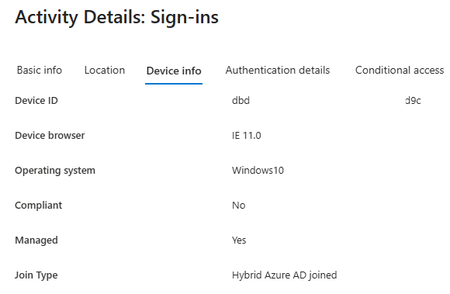
Background We have an EntraID (Azure/Microsoft365) SAML based VPN using the APM module and were keen to provide a different device pool to domain devices, rather than personal devices (BYOD). We noted that, in the EntraID logs, it included elements such as whether the device IsCompliant, IsKnown and/or IsManaged: Wrong step first We followed part of the exceptionally good video from Matthieu Dierick (https://www.youtube.com/watch?v=DBA84d4VJU8) in which he explains how to configure InTune to make the IsCompliant assertion and push a certificate onto the device to identify it.. and then the BIG-IP Edge client will send that certificate back to be used via an API call against InTune (even if EntraID isn't used for your APM authentication). To get the API bit to function we needed to follow the guidance in https://my.f5.com/manage/s/article/K00943512 But we aren't that far down the route with InTune and, without pushing that certificate, we got the error "Device ID was not found in session variables" (as explained in https://my.f5.com/manage/s/article/K93969130 ) To get working: Azure steps It seems exporting these variables isn't natively available through the GUI although there were some pointers available from Azure AD - SAML - Intune - ismanaged attribute - Microsoft Q&A In short, Navigate to: https://portal.azure.com/ Microsoft EntraID Under Manage > App registrations (this will default to "owned application") choose "all applications" tab Filter by the name of your SAML configuration Manage > Manifest Take a copy of the manifest incase you want to revert (note that it won't let you save it unless it can parse the input) Find the section "optional claims" and inject the following after any groups you pass back: "optionalClaims": { "accessToken": [], "idToken": [], "saml2Token": [ { "additionalProperties": [ "on_premise_security_identifier" ], "essential": false, "name": "groups", "source": null }, { "additionalProperties": [ ], "essential": true, "name": "is_device_managed", "source": null }, { "additionalProperties": [ ], "essential": true, "name": "is_device_compliant", "source": null }, { "additionalProperties": [ ], "essential": true, "name": "is_device_known", "source": null } ] }, To get working: APM steps In the visual policy editor you can now assign variables to those claims of the form: session.logon.last.isknown = mcget {session.saml.last.attr.name.http://schemas.microsoft.com/201 4/02/devicecontext/claims/isknown} session.logon.last.iscompliant = mcget {session.saml.last.attr.name.http://schemas.microsoft.com/201 4/09/devicecontext/claims/iscompliant} session.logon.last.ismanaged = mcget {session.saml.last.attr.name.http://schemas.microsoft.com/201 2/01/devicecontext/claims/ismanaged} So you can end up with a variable assignment box that looks like: (just be careful with copy/paste that it doesn't introduce spaces in the session variables) Then you can do a new general purpose > empty box with a branch rule evaluating: expr {[mcget {session.logon.last.ismanaged}] == "true"} Optionally you can record the output of these variables by adding a logging box with the entry: username=%{session.logon.last.username}, ismanaged=%{session.logon.last.ismanaged}, iscompliant=%{session.logon.last.iscompliant}, isknown=%{session.logon.last.isknown}451Views2likes6Comments
OAuth SSO
Hi All, we'd like to secure the access to a backend portal with OAuth (F5 Authorization Server and F5 Client/Ressource Server). We aleady configured 2 Virtual Servers and 2 Access Profiles access profile 1 for the backend application (OAuth Client and Scope Agents) access profile 2 for the OAuth AS (Logon Page, LDAP Auth and OAuth AS Agent) The login and the OAuth (OIDC) works with the backend via id_token. Idea was to ask the user ONCE for his LDAP Credentials and then authorize the user in subsequent authorization requests from client applications WITHOUT asking for entering his credentials again. What we see in the session logs is, that the authorization server session always ends with "session deleted (oauth_finished)" once the authorization request has successfully ended, hence the users LDAP information is destroyed together with the "session deleted" Is it possible to get some kind of SSO so that the users credentials is stored in the client for subsequent authorization requests and that the logon page can make use those credentials without prompting the user to login manually again? Thanks Steffen706Views2likes3CommentsA Method for Auth and SSO
Recently, we discovered Cyberark has moved from the traditional HTML based auth page to the new JavaScript based. So, our client initiated sso method isn't working anymore. Webssso process could not identify the html form objects because there is no html form anymore. The new design relies on a bunch of JavaScripts which coordinates client browser to send requested data to be able to login. I never interested in JS and could not point out where the user credential comes into play either. I've found out another method to make SSO function work again. It is very basic and relies on the sideband method but i prefer to use http auth agent rather than sideband iRule. Since the "Http Auth" profile can store the http status code along with the cookies of the HTTP request we made, we can use it for basic jobs as "Sideband Http Requestor" Long story short, basically we sent crafted login request to auth page and it returns a couple of cookies[1] if credentials are valid. Then we sent those cookies to the client as a reponse. That is all. An iRule with two distict function is good enoug for this particular job. One function is to prepare json payload which we sent to the web service and the other one is parse the cookies from the response of the web service. You need a custom "HTTP Auth" profile. You can take a look at the below[2] as an example. HTTP Auth profile can be used only with http services not https. In order to use Http Auth profile for sending & receiving http messages to an https web service, you need to use a http2https virtual server which translates requests and responses. In my example[2] i sent http requests through a fake virtual server which is listening on "54.54.54.54:80" socket. The cyberark servers are attached in the pool behind this virtual server. I used this method for Grafana first around a year ago and it is still working. The grafana has similar login page which relies on JS. Here is my iRule: when CLIENT_ACCEPTED { ACCESS::restrict_irule_events disable } when ACCESS_POLICY_COMPLETED { if {[ACCESS::session data get {session.policy.result}] == "allow" } { log local0. "APM Session Started Successfuly in [ACCESS::session data get {session.user.sessionid}] for [ACCESS::session data get {session.logon.last.username}]" log local0. "APM DEBUG: Policy Complete Cookies: $respCookie_0 $respCookie_1 $respCookie_2" ACCESS::respond 302 Location "https://testpam.example.com/PasswordVault/v10/Accounts" "Connection" "close" "Set-Cookie" ${respCookie_0} "Set-Cookie" ${respCookie_1} "Set-Cookie" ${respCookie_2} } } when HTTP_REQUEST { if {[HTTP::has_responded]} { return } if {[string tolower [HTTP::path]] == "/logoff"} { set sid [ACCESS::session data get {session.user.sessionid}] log local0. "Logging out from [ACCESS::session data get {session.user.sessionid}] for [ACCESS::session data get {session.logon.last.username}]" HTTP::respond 302 noserver Location "https://testpam.example.com/PasswordVault/v10" "Connection" "close" "Set-Cookie" "CA11111=; expires=Thu, 01-Jan-1970 00:00:00 GMT; path=/PasswordVault/; secure; HttpOnly; SameSite=Strict" "Set-Cookie" "CA22222=; expires=expires=Thu, 01-Jan-1970 00:00:00 GMT; path=/PasswordVault/; secure; HttpOnly; SameSite=Strict" "Set-Cookie" "CA66666=; expires=Thu, 01-Jan-1970 00:00:00 GMT; path=/PasswordVault/; secure; HttpOnly; SameSite=Stric" ACCESS::session remove -sid $sid } } when ACCESS_POLICY_AGENT_EVENT { if {[ACCESS::policy agent_id] == "LoginSessionCreate" } { # Generate JSON payload to sent the Cyberark v10 set uname [ACCESS::session data get {session.logon.last.username}] set passwd [ACCESS::session data get -secure {session.sso.token.last.password}] log local0. "APM DEBUG: User: $uname : $passwd" set payload {{"username":"UUUU","password":"PPPP"}} set cred "UUUU $uname PPPP $passwd" set payload [string map "$cred" $payload] log local0. "APM DEBUG: Payload $payload" ACCESS::session data set session.custom.http.payload $payload } if {[ACCESS::policy agent_id] == "CookiePreperation" } { #### HTTP Auth #### if {([ACCESS::session data get {session.http.last.response_cookie}] != "") && ([ACCESS::session data get {session.http.last.response_status}] == 200) } { # HTTP Auth Succeed set cookies [ACCESS::session data get {session.http.last.response_cookie}] log local0. "APM DEBUG: Raw Cookies: $cookies" set cookies [string trimright [string map { \\r\\n @ } $cookies] "@"] set cookies [split $cookies '@'] log local0. "APM DEBUG: Cookies Now: $cookies" set listCount 0 foreach cookie $cookies { if {![string match CA* $cookie]} { continue } log local0. "APM DEBUG: listCount: $listCount Cookie: $cookie" set respCookie_${listCount} $cookie incr listCount } log local0. "APM DEBUG: Total listCount: $listCount RespCookie: $respCookie_0 $respCookie_1 $respCookie_2" } } } I also have attached a screenshot of the APM policy. In that APM policy the "GrafanaLogin" is the HTTP Auth agent. Logging lines in the iRule can be suppressed as per your needs. Hope this is helpful for someone. [1]: Cookie names are: "CA11111", "CA22222", "CA66666" [2]: apm aaa http /Common/CyberArk_Login { auth-type custom-post connection-timeout 3 content-type none custom-body "%{session.custom.http.payload}" form-action http://54.54.54.54/PasswordVault/api/login/ headers { header0 { name Content-Type value application/json } } request-timeout 5 success-match-type cookie success-match-value CA11111 } May the source be with you...107Views1like0CommentsBIG-IP APM: RADIUS and SSO mapping broken
Hi All I think that using a combination of RADIUS authentication (with one-time token) and SSO credential mapping within APM is broken. Credentials entered on the logon page are stored in the username & password session variables. If you do a RADIUS authentication with one-time token, the password variable will be overwritten with the token. So an SSO credential mapping after the RADIUS authentication will get a wrong password. You can prevent this with either putting the SSO credential mapping before the RADIUS block, or "caching" the initial password in a separate variable with variable assign before ( password2 = password ) and after ( password = password2 ) the RADIUS block. However, this fix will not work if the user enters the wrong password initially. The RADIUS block will reload the login page and show you the "wrong credential" warning as often as you define, but the SSO credential mapping or variable assign defined BEFORE the RADIUS authentication won't be updated with the correct password. I know that I could set the "max. attempts allowed" to 1 and have a completely new APM session after every wrong credential or I could build a loop and lose the "wrong credential" message, but those 2 options are not that pretty in my opinion. I'm just wondering if someone has a nice solution to this problem. Cheers PatrickSolved2KViews1like4Comments
APM Single Sign-On: Forms - Client Initiated j_security_check issue
Hi, I'm trying to use "Single Sign-On: Forms - Client Initiated" to pass the Okta credentials to a web application running on Tomcat. The web application is returning the following form: <form data-empty-path="/APG/empty.html" id="login-form" method="post" action="j_security_check" > <input type="text" id="username" name="j_username" value="" tabindex="1" placeholder="User Name"/> <input type="password" id="password" name="j_password" value="" tabindex="2" placeholder="Password"/> <span class="error-message"> </span> <button type="submit" tabindex="3" class="ui-button ui-widget ui-state-default ui-state-disabled ui-corner-all ui-button-text-only"><span class="ui-button-text">Login</span></button> </form> My Form Definition settings are the following: - name = insightful_java - Detect request for form by: "URI" with Request URI: "/APG" - Identify Form by: Form Parameters with j_username=%{session.sso.token.last.username} and j_password=%{session.sso.token.last.password} - Disable Auto detect submit = No - Detect Login by = None - Javascript Injection = Auto Under these conditions I see that the form is not automatically filled in the /APG/j_security_check?f5-sso-form: insightful_java sent by my browser. Or better, I can see that the request is sent with query string parameter = "f5-sso-form: insightful_java", but the "Form Data" is empty My understanding is that the auto generated javascript code used with this setup is the following: <script> document.body.onkeydown=function(e){return false;}; document.body.style.visibility='hidden'; document.body.style.display='none'; function __f5submit() { var __f5form = document.forms[0]; __f5form.setAttribute('autocomplete', 'off'); __f5form['j_username'].value='giv'; __f5form['j_password'].value='f5-sso-token'; ; var __f5action = __f5form.action; var __f5qsep = (__f5action.indexOf('?') == -1) ? '?' : '&'; __f5form.action = __f5action + __f5qsep + 'f5-sso-form=insightful_java'; ; __f5form.submit(); } if (window.addEventListener) { window.addEventListener('load',__f5submit,false); } else if (window.attachEvent) { window.attachEvent('onload',__f5submit); } else { window.onload=__f5submit; } </script> Can you please help me to address this issue? Thanks. Roberto848Views1like0Comments
Assigning SSO profiles to different Portal Access items on a full Webtop
I have a webtop that displays an array of portal access objects based on APM's authentication and authorization (v12.1.2). There is an SSO profile assigned to the APM profile, but many of the portals link to apps that require a different SSO profile. On the portal access object, there is a single resource with a host name matching the Application URI, and a path of '/'. A different SSO profile is set here for those apps that can't use the default profile. It appears that the new profile is not assigned. APM Debug logging shows it attempting (and failing) to match against the URI list for the default SSO, not this app's SSO. I know that the individual SSO profiles are good, because I can change each one in for the default, and the apps that want that profile do SSO correctly. The rest go to double logons. How is this supposed to work?529Views1like4Comments
F5 IDP - ASP.NET SAML SSO example
Looking to add F5 IDP (APM) to our product SSO providers. We already connect to Azure AD (https://docs.microsoft.com/en-us/azure/active-directory/develop/quickstart-v2-aspnet-webapp), Okta (https://github.com/okta/samples-aspnetcore/tree/master/samples-aspnetcore-2x/self-hosted-login) and others using owin. There is an asp.net sdk or guide we can follow? Thanks!707Views1like0Comments