report
10 TopicsIntroducing F5 Insight for ADSP
Introduction F5 Insight for ADSP, a key component of the F5 Application Delivery and Security Platform (ADSP), helps teams monitor and secure apps that are spread across hybrid, multi-cloud and AI environments. In this article, I’ll highlight some of the key features and use cases addressed by F5 Insight. F5 Insight: Actionable intelligence to foster operational excellence Demo Videos Demo Video: Introduction to F5 Insight for ADSP Demo Video: F5 Insight - A Closer Look What is F5 Insight for ADSP? F5 Insight is a holistic solution that unifies every aspect of operating applications. It provides end-to-end visibility and operational narratives. It allows you to prioritize to-dos with health scores, anomaly detection, and report cards. It delivers clarity and value faster with views built by F5 experts. It provides expert guidance and optimization recommendations using natural language interactions. F5 Insight is not intended to replace SIEM solutions like Splunk or Sentinel but serves a different, complementary purpose. It’s an open-source tool designed specifically for monitoring and analyzing metrics from your BIG-IP devices. By leveraging open-source telemetry tools, it collects and presents data in a central, easy-to-read dashboard. This eliminates the need to log into individual interfaces like the CLI or GUI to sift through logs and metrics, offering streamlined visibility into your BIG-IP estate for simplified monitoring and analysis. Why is F5 Insight important? Gain out-of-the-box actionable intelligence to optimize application delivery and security: Get critical application and infrastructure performance data, operational analytics, security issues, and other telemetry in a unified tool. Surface important KPIs and data points fast by querying data using natural language with model context protocol (MCP) support. Optimize application delivery and security, as well as underlying resources, with built-in F5 expertise and guidance. Share data with F5 and use F5 AI Data Fabric for application health scores, security grades, and automatic identification and categorization of apps by type and workload (In Limited Availability) Speeds mean-time-to-innocence (MTTI) and mean-time-to-restore (MTTR) with actionable intelligence and proactive alerts. Streamlines monitoring and analysis while being able to run on its own and integrate with your existing Grafana/VictoriaMetrics stacks. Leverage data to make the business case and prove ROI for more resources, application migrations, or system refreshes. How does F5 Insight work? F5 Insight is deployed as a Virtual Machine. This gives you full access and control of your F5 BIG-IP telemetry data. The configuration is simple, log into the F5 Insight portal and add your BIG-IP devices. There is no configuration needed on BIG-IP itself. Ready to get started? Log into the F5 Insight portal: By default you will arrive at the Home screen. From the navigation menu, under Manage, click BIG-IP Settings to add your BIG-IP devices. Before we add the BIG-IP devices click the Data Centers tab and then Add Data Center. This allows you to specify a location for the BIG-IP devices. Give it a Name, San Jose, CA in this example. Click Add Data Center. Go back to the Devices tab and click Add Device. Note that you can add a single device from here or add multiple devices using the Upload YAML Files (more on this later). For now, let’s add a single device using the management address or Endpoint, Username and Password. Scroll down and specify the Certificate Authority if using custom TLS certificates on BIG-IP devices. Under Data Center select the Data Center created previously, San Jose, CA in this example. Note: if you didn’t create a Data Center you can still do it now. Under Modules select the BIG-IP Modules you are using. In this example I selected Policy Firewall (or AFM). Click Add Device. The BIG-IP from San Jose has been added. From the navigation menu select BIG-IP Device then Device Overview to see more details. Note: you can select the specific Device you want to view. Important details are shown on this screen. Some items of interest are the BIG-IP version, system model or VM, Licenses and Enabled Modules. The Home Screen displays System Report Cards and allows you to drill down into the individual widgets. System Report Cards provide at-a-glance health indicators for four critical monitoring categories. Each card displays a status badge (Good, Warning, or Critical) based on deviation thresholds. Note: you can filter the Home Screen to display a specific Data Center. Adding Multiple BIG-IPs using YAML File Upload For bulk onboarding or infrastructure-as-code workflows, import devices using YAML configuration. Using YAML streamlines bulk onboarding, ensures consistency, improves scalability, simplifies automation, and increases accuracy. It also ensures integration with IaC workflows and CI/CD pipelines—enabling reusable, version-controlled configurations. From the BIG-IP Settings screen select Add Device. Upload your Defaults and Receiver YAML files here or click Paste YAML to copy/paste them. Note: YAML import also supports configuring F5 Insight features such as high availability, LLM Insights, AIDF, and data retention policies alongside device definitions. Both BIG-IPs are now connected to F5 Insight When you return to the BIG-IP Settings screen it should look like this: A correctly configured ast-defaults.yaml file will look like the following. Note: enter the username and password to log into your BIG-IPs A correctly configured ast-receivers.yaml file will look like the following. Note: enter a Device Name and Endpoint address. Conclusion F5 Insight for ADSP offers customizable visualizations and dashboards to help teams surface actionable metrics and KPIs tailored to your organization. It provides access to useful telemetry data for a deeper understanding of your environment, application behaviors, and complex BIG-IP deployments, all centralized in a single location. Identification of root causes during outages/tickets. Solves issues and struggles with Day 2 analysis of your BIG-IP Fleet and the applications therein. Mitigates the problem of a lack of detailed visual information on your BIG-IP Fleet. Set a foundation for the utilization of open-source tools and their benefits. Related Content F5 Insight for ADSP BLOG F5 Insight Documentation F5 Insight Product Page3.2KViews4likes0Comments
F5 iControl REST API - viewBy Parameter Issue in Analytics Report
Hi everyone, I'm currently working with the F5 iControl REST API to generate an analytics report from the Application Security Manager (ASM) module. According to the F5 documentation, the API endpoint for generating a report is: /mgmt/tm/analytics/application-security/report Reference https://clouddocs.f5.com/api/icontrol-rest/APIRef_tm_analytics_application-security_report.html Issue Description The API documentation states that the viewBy parameter is required. However, I encountered conflicting behaviors: If I don't provide viewBy, the API response states that it is required. {"code":400,"message":"You must enter a view-by entity name","errorStack":[],"apiError":26214401} If I provide viewBy (e.g., attack-type), the API returns a 400 Bad Request error with the message:{"code":400,"message":"Query parameter viewBy is invalid.","errorStack":[],"apiError":1} I also tried both view-by/viewBy/viewby, but neither worked. My Test Code Here is the Python script I used to call the API: # API Endpoint API_ENDPOINT = "/mgmt/tm/analytics/application-security/report" # Query Parameters params = { "view-by": "attack-type" } Questions What are the valid values for the viewBy parameter? Has anyone successfully used this API endpoint? If so, could you share a working example? Any help or insights would be greatly appreciated. Thanks in advance!197Views0likes1Comment
Hi - Need to export VIP name, IP, status (offline/available/unknown), pool and Poolmembers
Hi, I went through many articles but couldn't find any script for a consolidated report that would have these details: VIP name VIP IP VIP Status (offline/available/unknown) pool poolmembers I did find separate articles though but not a consolidated one. I am new and not verse with scripting. https://my.f5.com/manage/s/article/K72255145 https://my.f5.com/manage/s/article/K000135606 If anyone can please help with this required script it would be of great help. Thanks in advance. Regards, Ravi277Views0likes1Comment
How to generate ASM report from a pre-defined filter using TMSH
Is there a way to generate a report using a pre-defined report (filter) using CLI (TMSH)? Though I should be able to generate the same report by typing down the filter for the report in TMSH but TMSH does not understand the Drilldown for Security Policy for some reason. For instanace, when I try to run the following command it is not able to identify the Policy save analytics application-security report view-by attack-type measures { occurrences } drilldown {{ entity policy values { My_Security_Policy_Name } } } format pdf file foo.pdf range now-3w The error I get for above is : Data Input Error: Invalid entity value My_Security_Policy_Name This is strange because I am able to see and set Security Policies in the filter in GUI. I am using Big-IP 12.1.0.292Views0likes0Comments
Export GTM/DNS Configuration in CSV - tmsh cli script
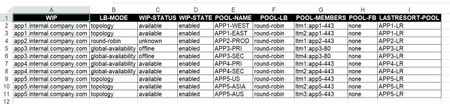
Problem this snippet solves: This is a simple cli script used to collect all the WideIP, LB Method, Status, State, Pool Name, Pool LB, Pool Members, Pool Fall back, Last Resort pool info in CSV format. A sample output would be like below, One can customize the code to extract other fields available too. Check out my other codeshare of LTM report. Note: The codeshare may get multiple version, use the latest version alone. The reason to keep the other versions is for end users to understand & compare, thus helping them to modify to their own requirements. Hope it helps. How to use this snippet: Login to the GTM/DNS, create your script by running the below commands and paste the code provided in snippet, tmsh create cli script gtm-config-parser Delete the proc blocks, so it looks something like below, create script gtm-config-parser { ## PASTE THE CODE HERE ## } and paste the code provided in the snippet. Note: When you paste it, the indentation may be realigned, it shouldn't cause any errors, but the list output would show improperly aligned. Feel free to delete the tab spaces in the code snippet & paste it while creating, so indentation is aligned properly. And you can run the script like below, tmsh run cli script gtm-config-parser > /var/tmp/gtm-config-parser-output.csv And get the output from the saved file, open it on excel. Format it & use it for audit & reporting. cat /var/tmp/gtm-config-parser-output.csv Feel free to add more elements as per your requirements. For version 13.x & higher, there requires a small change in the code. Refer the comments section. Thanks to @azblaster Code : proc script::run {} { puts "WIP,LB-MODE,WIP-STATUS,WIP-STATE,POOL-NAME,POOL-LB,POOL-MEMBERS,POOL-FB,LASTRESORT-POOL" foreach { obj } [tmsh::get_config gtm wideip all-properties] { set wipname [tmsh::get_name $obj] set wippools [tmsh::get_field_value $obj pools] set lbmode [tmsh::get_field_value $obj "pool-lb-mode"] set lastresort [tmsh::get_field_value $obj "last-resort-pool"] foreach { status } [tmsh::get_status gtm wideip $wipname] { set wipstatus [tmsh::get_field_value $status "status.availability-state"] set wipstate [tmsh::get_field_value $status "status.enabled-state"] } foreach wippool $wippools { set pool_name [tmsh::get_name $wippool] set pool_configs [tmsh::get_config /gtm pool $pool_name all-properties] foreach pool_config $pool_configs { set pool_lb [tmsh::get_field_value $pool_config "load-balancing-mode"] set pool_fb [tmsh::get_field_value $pool_config "fallback-mode"] if { [catch { set member_name [tmsh::get_field_value $pool_config "members" ]} err] } { set pool_member $err } else { set pool_member "" set member_name [tmsh::get_field_value $pool_config "members"] foreach member $member_name { append pool_member "[lindex $member 1] " } } puts "$wipname,$lbmode,$wipstatus,$wipstate,$pool_name,$pool_lb,$pool_member,$pool_fb,$lastresort" } } } } Tested this on version: 11.64.9KViews2likes6Comments
SSL Cert expiration Tracker
Problem this snippet solves: Script is useful for large F5 LTM infrastructure. Instead of checking certs being expired on individual LTM, just list all your LB's in single file and script will check and create a report. How to use this snippet: This is made up of 3 parts: 1- hosts file (hosts.txt) 2- The Script 3- Report (bigip.data) Make sure you have Python 3 installed on your system. Install F5 SDK - i.e "pip install f5-sdk" and other modules such as dateutil, getpass, datetime etc. Create Text file "hosts.txt" and keep it in same directory as script. List all your LB's in "hosts.txt", each on new line. That's all! Run the script. If you face any issue let me know. Please provide any suggestions. Code : 926011.2KViews0likes3Comments
Report: 1) All servers which are behind ASM in transparent/blocking 2) All active attack signatures in the policy
Hello! I have a requirement from management for 2 reports: 1) a report which lists all the current servers with ASM active I tried to get this info from ArcSight SIEM but the hostname field is empty and all I get is IP address. 2) second report which lists all active attack signatures for a policy I tried exporting the policy but there are only signature numbers. Any suggestion how I could accomplish the mentioned tasks?Solved690Views0likes4CommentsSSL Certificate Usage Report
Our client has an fast approaching, expiring SHA1 SSL certificate and we need to plan for importing the new cert, creating a new Profile and and updating all LTM Virtuals accross all VCMP's Before we can do this, we need to identify the SSL Cert used in each SSL client profile on each VS on each VCMP! I have tried using the command: tmsh list / ltm virtual one-line | grep $cert But this doesn't always list VS that are in different partitions other than /Common Is there an easier way to identify which VS uses the SSL Cert used in each SSL client profile? To make matters worse, the previous company that set up the implemented different names and variations of client ssl profiles that use various combinations of the same certificate or a different file of the same certificate! Note: We also have two VCMP's licenced with the APM module, which may or may not be of importance here.287Views0likes0Comments