advanced waf
56 TopicsProtecting Your MCP Server From Secret Exposure With F5 BIG-IP Advanced WAF's Data Guard
The Threat of Token Mismanagement in MCP Servers Tokens and credentials serve as the backbone for authentication and authorization in MCP servers, yet their mishandling presents a significant security risk. Developers sometimes store these secrets insecurely, embedding them in configuration files or leaving them easily accessible. The inherent features of MCP—such as long-lived sessions, stateful agents, and persistent context—add complexity to this risk. Tokens can inadvertently be stored, retrieved, or indexed through user prompts, system recalls, or log inspections. This introduces a new vulnerability: contextual secret leakage, where the model or protocol layer unknowingly becomes a repository for sensitive information. Attackers can exploit this vulnerability to extract and misuse these exposed credentials, gaining unauthorized access production systems. Mitigating OWASP MCP01 with F5 BIG-IP Advanced WAF Data Guard Recognizing the gravity of this issue, OWASP has officially categorized Token Mismanagement and Secret Exposure in MCP servers under the MCP01 vulnerability class. This classification highlights the widespread nature of the threat and underscores the urgent need for tools like F5 BIG-IP Advanced WAF’s Data Guard. Although the long term solution is to correct token mismanagement at the backend servers, the F5 BIG-IP Advanced WAF’s Data Guard offers a quick and easy way to mitigate this vulnerability. By sanitizing server responses, Data Guard ensures that sensitive data—such as tokens—is never inadvertently exposed to unprivileged users. In the following video, we will see how token mismanagement can result in system error logs containing sensitive data. Subsequently, we demonstrate how we can utilize BIG-IP Advanced WAF Data Guard to sanitize these responses, thus mitigating OWASP MCP 01: Token Mismanagement & Secret Exposure. For more information on F5 Data Guard, click here. For a list of OWASP MCP Top 10 vulnerabilities, click here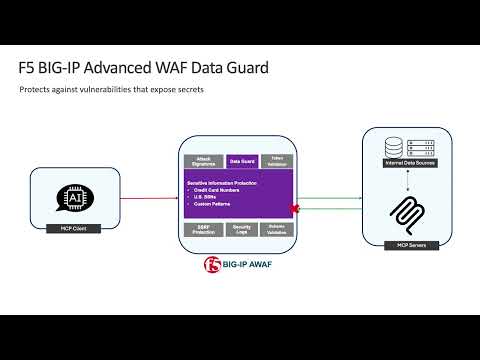 97Views1like0Comments
Protecting your MCP Server from AI Vulnerabilities with F5 BIG-IP Advanced WAF JSON Schema Validation
This demo shows how a JSON schema can inform the BIG-IP how requests should be expected to come in. The F5 BIG-IP Advanced WAF can mitigate MCP server vulnerabilities by sanitizing parameters in requests allowing them to pass through to the MCP server. This demo covers two vulnerabilities from OWASP MCP Top 10. For more info on the OWASP MCP Top 10 vulnerabilities, click here. MCP02: Privilege Escalation via Scope Creep Scope creep can occur intentionally for convenience or accidentally through configuration drift allowing an agent to gain broad or administrative privileges to our MCP Server. As MCP servers connect to multiple systems, scope increases can result in a high-impact attack surface. Due to the nature of AI agents, an over-privileged agent can make unlabeled changes, trigger deployments, or access sensitive data without human review. For more information on OWASP MCP02: Privilege Escalation via Scope Creep, click here. MCP03: Tool Poisoning Schema poisoning occurs when an adversary tampers with the contract or schema definitions that govern agent-to-tool interactions in an MCP ecosystem. Schemas define the shape, types, and semantics of requests and responses — effectively the “language” agents use to call tools. If an attacker can modify a schema (or its metadata) so that a benign-sounding operation maps to a destructive action, agents that trust and follow the schema may inadvertently execute dangerous commands. Schema attacks are a supply-chain style compromise: the attacker doesn’t exploit a code bug directly, they change the contract so legitimate agents behave incorrectly while passing superficial validation. For more information on OWASP MCP03: Tool Poisoning, click here. Mitigating MCP02 and MCP03 Enforcing JSON Schema validation at the BIG-IP can mitigate requests that may allow excessive privilege to resources on our MCP server. This method gives security admins more control over how their MCP server can be used. In this video, we will demonstrate how an attacker can exploit MCP02 and MCP03 to gain access to resources unintended for them. Subsequently, we use JSON Schema validation to inform the F5 BIG-IP Advanced WAF's security policy on how a security admin would intend those resources to be accessed. Check out the video below for a demonstration of how the F5 BIG-IP's JSON Schema validation can mitigate MCP 02 and MCP 03. 218Views2likes0Comments
F5 BIG-IP Virtual Patching With Web App Scanning Results
F5 Distributed Cloud Web App Scanning offers automated penetration testing capabilities for web applications and APIs. The scanning methodology is designed to address vulnerabilities as defined by the OWASP Top 10 for web apps and LLMs, ensuring robust coverage against commonly exploited risks and emerging threats. Following each scan, the tool generates a detailed report, which serves as a valuable resource for defining and enhancing your F5 security policies. For more information about Web App Scanning, visit the official documentation. When paired with the BIG-IP Advanced WAF, F5 Distributed Cloud Web App Scanning allows you to protect applications from a wide range of attacks, including those that exploit known vulnerabilities. By integrating the two solutions, vulnerabilities identified during scans can be automatically exported to BIG-IP Advanced WAF to apply virtual patches, providing seamless security enhancements for your applications. This video demonstration walks you through the process of exporting vulnerabilities detected by F5 Distributed Cloud Web App Scanning to a service secured by BIG-IP Advanced WAF (AWAF). With this integration, you can apply targeted virtual patches to endpoints in your applications. The key steps demonstrated include: Using the Vulnerability Assessment Policy Template: Begin by creating a baseline security policy in BIG-IP Advanced WAF, leveraging its integration with F5 Distributed Cloud Web App Scanning. Integrating Vulnerability Details: The output from F5 Distributed Cloud Web App Scanning can be imported, providing suggested updates to your security policy that specifically address the vulnerabilities identified during the scan. Custom Vulnerability Handling: Select which vulnerabilities should be addressed by the security policy according to your application’s requirements. Retesting the Security Policy: Re-run the Web App Scan to validate that the enhanced security policy effectively protects against the previously identified vulnerabilities. For more information on exporting vulnerability scan results from F5 Distributed Cloud Web App Scanning to BIG-IP Advanced WAF, visit the official documentation. 554Views2likes1Comment
Need step-by-step guidance for migrating BIG-IP i2800 WAF to rSeries (UCS restore vs clean build)
Hello DevCentral Community, We are planning a hardware refresh migration from a legacy BIG-IP i2800 running WAF/ASM to a new rSeries platform and would like to follow F5 recommended best practices. Could you please advise on the step-by-step process for this migration, specifically around: o Whether UCS restore is recommended versus building config fresh o BIG-IP version compatibility considerations during the migration o Interface/VLAN mapping differences between iSeries and rSeries hardware o Best approach to migrate WAF/ASM policies and tuning after migration o Common issues or lessons learned during real-world cutovers Current environment: " BIG-IP model: i2800 " BIG-IP version: 17.1.3 " WAF module: ASM / Advanced WAF " Deployment: Active/Active Thank you .637Views0likes3CommentsOverview of MITRE ATT&CK Tactic: TA0040 - Impact
This article focuses on the Impact Tactic, and the techniques adversaries use to manipulate, disrupt or damage the systems and data as they reach the final stage of an attack. This is one of the critical tactics, as it highlights the adverse effects attackers can cause, including exploitation, operational disruption, data destruction, or financial gain579Views1like1CommentOverview of MITRE ATT&CK Tactic - TA0011 Command and Control
Introduction In modern days, cyber violations, command and control are one of the main set of techniques with which attackers can gain control over the system within a victim’s network. Once control is gained over the system, the attackers can steal sensitive data, move laterally and blend into normal activity. Command and Control (MITRE ATT&CK Tactic TA0011) represents another critical stage of the adversary lifecycle, where the adversaries focus on communicating with the systems under their control. There are multiple ways to achieve this, either by mimicking the expected traffic flow to avoid detection or mimicking a normal behavior of the compromised system. To avoid the vulnerability, it is important for defenders to understand how communication is established to any system in the network and the various levels of stealth depending on the network structure. This article walks through the most common Command and Control techniques, and how F5 solutions provide strong defense against them. T1071 - Application Layer Protocol To communicate with the systems, the adversaries blend in with the existing traffic of the OSI layer protocols to avoid detection/network filtering. The results of these commands will be embedded within the protocol traffic between the client and the server. T1071.001 - Web Services Adversaries mimic normal, expected HTTP/HTTPS traffic that carries web data to communicate with the systems under their control within a victim network. T1071.002 - File Transfer Protocol Protocols used to implement this technique includes SMB, FTP, FTPS and TFTP. The malicious data is concealed within the fields and headers of the packets produced from these protocols. T1071.003 - Mail Protocols Protocols carrying electronic mail such as SMTP/S, POP3/S, and IMAP is utilized by concealing the data within the email messages themselves. T1071.004 - DNS An administrative function in computer networking is served by the DNS Protocol, and DNS traffic may also be allowed even before the authentication of the network. Data is concealed in the fields and headers of these packets. T1071.005 - Publish/Subscribe Protocols For message distribution managed by a centralized broker, where Publish/Subscribe design utilizes MQTT, XMPP, AMQP and STOMP protocols. T1092 - Communication Through Removable Media On disconnected networks, command and control between the compromised hosts can be performed using removable media to execute commands from system to system. For a successful execution, both systems need to be compromised and need to replicate the removable media through lateral movement. T1659 - Content Injection Adversaries may also gain control over the victim’s system by injecting malicious content into the systems, by initially accessing the compromised data-transfer channels where the traffic can be manipulated or content can be injected. T1132 – Data Encoding Another technique to gain control over the system is by encoding the information using a standard data encoding system. Encoding includes the use of ASCII, Unicode, Base64, MIME or other binary-to-text encoding systems. T1132.001 - Standard Encoding Data Encoding schemes utilized for Standard Encoding includes ASCII, Unicode, hexadecimal, Base64 and MIME. Data compression, such as gzip, are also an example of standard encoding. T1132.002 - Non-Standard Encoding Data Encoded in the message body of an HTTP request, such as modified Base64, is utilized as encoding schemes. T1001 – Data Obfuscation Obfuscation of command-and-control communication is hidden as part of this technique, making it even more difficult to discover or decipher. The focus is to make the communication less conspicuous and hidden, by incorporating several methods, which create below sub-techniques: T1001.001 - Junk Data Adversaries may abuse the protocols by adding random, meaningless junk data to the protocols, which can prevent trivial methods for decoding or deciphering the traffic. T1001.002 - Steganography Steganographic sub-techniques are used to transfer hidden digital data messages between systems, such as images or document files. T1001.003 - Protocol or Service Impersonation Adversaries can impersonate legitimate protocols or web services, to command-and-control traffic by blending in with legitimate network traffic. T1568 – Dynamic Resolution To establish connections dynamically to command-and-control the infrastructure and prevent any detections, adversaries use malware sharing a common algorithm with the infrastructure to dynamically adjust the parameters, such as a domain name, IP address, or port number. T1568.001 - Fast Flux DNS Fast Flux DNS is used to hide a command-and-control channel behind an array of rapidly changing IP addresses linked to a single domain resolution. T1568.002 - Domain Generation Algorithm Rather than relying on a list of static IP addresses or domains, adversaries may utilize Domain Generation Algorithms to dynamically identify a destination domain for command-and-control traffic. T1568.003 - DNS Calculations Instead of utilizing the predetermined port number or the actual IP address, to dynamically determine which port and IP address to use, adversaries calculate on addresses returned in DNS results. T1573 – Encrypted Channel Adversaries rely on an encrypted algorithm channel to conceal command-and-control traffic rather than depending on any inherent protections by the communication protocols. T1573.001 - Symmetric Cryptography Symmetric Encryption Algorithms, such as AES, DES, 3DES, Blowfish and RC4, use keys for plaintext encryption and ciphertext decryption. T1573.002 - Asymmetric Cryptography Asymmetric cryptography, or public key cryptography, uses a keypair per party: one public and one private. The sender encrypts the data with the receiver’s public key, and the receiver decrypts the data with their private key. T1008 – Fallback Channels If the primary channel is compromised or inaccessible, then in order to maintain reliable command and control, adversaries use fallback communication channels. T1665 – Hide Infrastructure To hide and evade detection of the command-and-control infrastructure, adversaries identify and filter traffic from defensive tools, masking malicious domains to abuse the true destination, and otherwise hiding malicious contents to delay discovery and prolong the effectiveness of adversary infrastructure. T1105 – Ingress Tool Transfer Tools or other files transfer from an external adversary-controlled source into the compromised environment through controlled channels or protocols such as FTP. Also, adversaries may spread tools across the compromised environment as part of Lateral Movement. T1104 –Multi-Stage Channels To make detection more difficult, adversaries create multiple stages for command-and-control for several functions and different conditions. T1095 – Non-Application Layer Protocol To communicate between the host and command-and-control server, adversaries use non-application layer protocols, such as ICMP (Internet Control Message Protocol), UDP (User Datagram Protocol), SOCKS (Secure Sockets), or SOL (Serial over LAN). T1571 – Non-Standard Port Adversaries communicate using port pairings that are not associated with the protocol, for, say, HTTPS over port 8088 or port 587 as opposed to the traditional port 443. T1572 – Protocol Tunneling Another approach to avoid detection/network filtering is to explicitly encapsulate a protocol within another protocol to enable routing of network packets which otherwise not reach their intended destination, such as SMB, RDP. T1090 – Proxy To direct network communications to a command-and-control server to avoid direct connections to the infrastructure and override the existing actual communication paths to avoid suspicion and manage command-and-control communications inside a compromised environment, proxy act as an intermediary between the systems, such as, HTRAN, ZXProxy and ZXPortMap. T1090.001 - Internal Proxy Internal proxies are primarily used to conceal the actual destination while reducing the need for multiple connections to external systems, such as peer-to-peer (p2p) networking protocols. T1090.002 - External Proxy External proxy is used to mask the true destination of the traffic with port redirectors. Purchased infrastructure such as Virtual Private Servers which are the compromised systems outside the victim's network, are generally used for these purposes. T1090.003 - Multi-Hop Proxy Multiple proxies can also be chained together to abuse the actual traffic directions, making it more difficult for defenders to trace malicious activity and identify its source. T1090.004 - Domain Fronting Adversaries can even misuse Content Delivery Networks (CDNs) routing schemes to infect the actual HTTPS traffic destination or traffic tunneled through HTTPS. T1219 – Remote Access Tools To access the target system remotely and establish an interactive command-and-control within the network, remote access tools are used to bridge a session between two trusted hosts through a graphical interface, a CLI, or a hardware-level access (KVM, Keyboard, Video, Mouse) over IP solutions. T1219.001 - IDE Tunneling IDE Tunneling combines SSH, port forwarding, file sharing and letting the developers gain access as if they are local, by encapsulating the entire session and tunneling protocols alongside SSH, allowing the attackers to blend in with the actual development workflow. T1219.002 - Remote Desktop Software Adversary may access the target systems interactively through desktop support software, which provides a graphical interface to the remote adversary, such as VNC, Team Viewer, AnyDesk, LogMein, are commonly used legitimate support software. T1219.003 - Remote Access Hardware To access the legitimate hardware through commonly used legitimate tools, including IP-based keyboard, video, or mouse (KVM) devices such as TinyPilot and PiKVM. T1205 – Traffic Signaling Traffic signaling is used to hide open ports or any other malicious functionality to prolong command-and-control over the compromised system. T1205.001 - Port Knocking To hide the open ports for persistence, port knocking is included, to enable the port, in which the adversary sends a series of attempted connections to a predefined sequence of closed ports. T1205.002 - Socket filters Socket Filters are filters to allow or disallow certain types of data through the socket. If packets received by the network interface match the filtering criteria, desired actions are triggered. T1102 – Web Service Adversaries use an existing, legitimate external Web Service to transfer data to/from the compromised system. Also, web service providers commonly use SSL/TLS encryption, which gives adversaries an additional level of protection. T1102.001 - Dead Drop Resolver Adversaries post content called dead drop resolver on Web Services with encoded domains. These resolvers will redirect the victims to the infected domain/IP addresses. T1102.002 - Bidirectional Communication Once the system is infected, they can send the output back to the Web Service Channel. T1102.003 - One-Way Communication Compromised Systems may not return any output at all in a few cases where adversaries tend to send only one way instructions and do not want any response. How F5 Can Help F5 security solutions provide multiple different functionalities to secure and protect applications and APIs across various platforms including Clouds, Edge, On-prem or Hybrid. F5 supports risk management solutions mentioned below to effectively mitigate and protect against command-and-control techniques: Web Application Firewall (WAF): WAF is supported by all the F5 deployment modes, which is an adaptable, multi-layered security solution that defends web applications against a broad spectrum of threats, regardless of where they are deployed. API Security: F5 offers to ease the security of APIs with F5 Web Application and API Protection (WAAP) solutions, which protects API endpoints and other API dependencies by restricting the API definitions using specified rules and schemas. Rate-Limiting & Bot Protection: Brute-force, credential stuffing, and session attacks can be mitigated with configurable thresholds and automated bot protection. For more information, please contact your local F5 sales team. Conclusion Command and Control (C2) encompasses the methods adversaries employ to communicate with compromised systems within a target network. Adversaries disguise their C2 traffic as legitimate network activity to evade detection. To defend against Command-and-Control techniques, defenders should gain a clear understanding of implementation of robust segmentation and egress filtering using Web Application Firewalls (WAF) to limit communication channels and regularly monitor traffic for anomalous patterns and leverage threat intelligence to identify any C2 indicator. Additionally, employing endpoint detection and response (EDR) using API Security solutions can help detect and block malicious C2 activity at the host level. Reference links MITRE | ATT&CK Tactic 09 – Command and Control MITRE ATT&CK: What It Is, how it Works, Who Uses It and Why | F5 Labs MITRE ATT&CK®875Views1like1Comment