rate limiting
8 TopicsProtecting APIs with Access Policy Manager and custom iRules
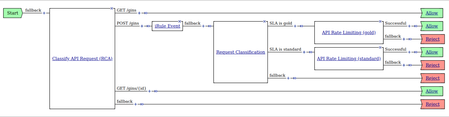
The problem: Unprotected API - Vulnerable to Overload Without Rate-Limiting Enforcement Our customer in the B2B sector is encountering a challenge with their public API. Despite having implemented a custom method for generating long-lived API keys, they find themselves unable to enforce rate-limiting effectively. This absence of rate-limiting mechanisms poses significant challenges, potentially resulting in the overloading of their system due to excessive requests or the exploitation of their API by unauthorized users. Without proper rate-limiting controls in place, the customer faces risks to both the performance and security of their API infrastructure, necessitating a solution to mitigate these concerns and ensure the smooth operation of their services for their clients. Our customers wants to offer two tiers of service level agreements (SLAs) - gold and standard. Complicating matters further, the API key, integral to authentication, is transmitted via a custom HTTP header. The solution: BIG-IP APM and Custom iRules for Effective Rate-Limiting My solution involves leveraging the API Protection feature of BIG-IP APM in conjunction with a custom iRule. By utilizing this combination, our customer can effectively extract the API Keys from HTTP requests and enforce rate limiting on specific API endpoints. As for now they only want to enforce rate limiting on the POST endpoints. This approach empowers the customer to secure their API while efficiently managing and controlling access to critical endpoints, ensuring optimal performance and safeguarding against abuse or overload. With this iRule we can to extract the API key from the HTTP Requests and store it in a variable, that can later be used by the API Protection feature of the APM. API Keys and the associated SLA level are stored in a Data Group of the type string. # Enable (1) or disable (0) logging globally when RULE_INIT { set static::debug 1 } # Access and analyze the HTTP header data for SLA value when HTTP_REQUEST { set sla [class lookup [HTTP::header value apikey] dg_apikeys] if { $static::debug } {log local0. "Made it to HTTP_REQUEST event with SLA value $sla."} } # Evaluate SLA value during per-request access policy execution when ACCESS_PER_REQUEST_AGENT_EVENT { set id [ACCESS::perflow get perflow.irule_agent_id] if { $id eq "read-sla" } { if { $static::debug } {log local0. "Made it to iRule agent in perrequest policy with SLA value $sla."} ACCESS::perflow set perflow.custom "$sla" } } And this is how the Per Request Policy in the API Protection profile looks. It uses the value of the API Key (extracted with the help of the the iRule) and the Source IP of the client to enforce Rate Limiting on the POST endpoints, using two different SLAs. In the APM log you should see the following message, once the client exceeds his quota defined in the SLA. Apr 28 20:12:42 ltm-apm-16.mylab.local notice tmm[11094]: 01870075:5: (null):/Common: API request with weight (1) violated the quota in rate limiting config(/Common/demo_api_ratelimiting_auto_rate_limiting_standard). Apr 28 20:12:42 ltm-apm-16.mylab.local notice tmm[11094]: 0187008d:5: /Common/demo_api_ratelimiting_ap:Common:6600283561834577940: Execution of per request access policy (/Common/demo_api_ratelimiting_prp) done with ending type (Reject) Further reading: You can find a more detailed write-up on my GitHub page: https://github.com/webserverdude/f5_APM_API_Protection There you can find the Per Request Policy explained in all details. The Data Group with for the iRule. A demo API for testing my solution. A Postman Collection for working with my demo API.286Views2likes0CommentsEffective Traffic Management: Addressing ADC04's Insufficient Traffic Controls
Applications today face unprecedented demand variability, requiring organizations to prioritize effective traffic management to ensure a seamless user experience. ADC04, one of the key challenges in application delivery per F5's "Application Delivery Top 10," highlights insufficient traffic controls. This issue plagues high-demand environments across industries such as e-commerce, healthcare, high-tech, automotive, insurance, and more, leading to performance bottlenecks, reduced availability, inefficiencies, and scalability challenges. Let's discuss the implications and solutions for this issue, with an added use case to demonstrate practical implementation. AI Reference Architecture The Challenge of Insufficient Traffic Controls Modern digital ecosystems experience fluctuating traffic volumes due to use cases like e-commerce promotions, flash sales, or API-driven workloads. For example, an e-commerce API could go from handling hundreds of requests per second (RPS) to thousands or more during promotional events. Without proper rate limiting, throttling, or caching mechanisms, public APIs become vulnerable to overburdened backend services, Distributed Denial of Service (DDoS) attacks, and inefficient scaling. Automated processes, such as analytics workloads, CI/CD deployments, and backups, exacerbate uneven workloads on backend systems. Furthermore, modern AI applications with data-intensive processing introduce yet another layer of complexity, requiring sophisticated traffic controls. The Consequences of Inefficient Traffic Controls Performance Issues Excessive traffic without sufficient controls leads to backend overload, degrading application response time. For example: User Frustration: Slow response times result in poor customer experiences, where 70% of shoppers abandon purchases due to delays. Critical Application Failures: In AI use cases, such as real-time conversational bots, processing delays impact outcomes and user trust. Reduced Availability API services lacking rate limiting and traffic throttling are especially prone to DDoS attacks or service outages. Additionally, backend systems may face resource starvation due to unoptimized caching mechanisms, reducing availability even during normal traffic conditions. Limited Scalability Applications unable to intelligently manage traffic flows struggle to handle unexpected traffic spikes. Inefficient caching and chaotic workload distribution limit the capacity to scale dynamically. Operational Inefficiencies The absence of automated traffic controls forces manual monitoring and intervention during traffic surges. High operational overhead and inefficient resource usage affect cost-effective management of infrastructure. Use Case example: Implementing Traffic Controls for an E-Commerce Public API The diagram below illustrates a practical implementation of traffic controls using advanced Application Delivery Controller (ADC) features (e.g., BIG-IP Local Traffic Manager) for an e-commerce public API. While tailored for e-commerce, these are equally applicable to other industries, such as finance, insurance, high-tech, and automotive. Key Features for Effective Traffic Management: Global Rate Limiting: Enforces a cap on total requests per second (RPS) to avoid backend overload. Per-API Key Throttling: Limits RPS at an API key level (e.g., 100 RPS per user), ensuring fair usage. CAPTCHA Trigger: Introduces CAPTCHA challenges for clients exceeding predefined limits to mitigate abuse. Circuit Breaker Logic: Detects faults in backend API servers and reroutes traffic to stable instances where possible. Traffic Forwarding or Rejection: Directs healthy requests to backend API servers and rejects problematic traffic. Comprehensive Logging and Metrics: Logs control events, such as rate-limit breaches or circuit-break activations, and streams them into observability platforms like ELK, Prometheus, or Datadog for dashboards and automated alerts. Functionality Overview Clients Send API Requests: Public API clients interact with the ADC (BIG-IP LTM), where all incoming requests are initially processed. Rate Limiting and Key Enforcement: The ADC enforces global rate limits and per-client throttling policies to avoid overloading backend servers. Action on Violations: Requests breaching limits trigger appropriate actions—delays, CAPTCHAs, or outright rejection. Health-Check Monitoring: The ADC regularly monitors backend API servers for faults and dynamically reroutes traffic to healthy nodes using circuit-breaker policies. Logs and Metrics Streaming: All traffic patterns, rule activations, and violations are logged and streamed to observability platforms for operational transparency. Best Practice Recommendations for Traffic Controls Rate Limiting and Throttling Global and per client rate limits are critical for protecting backend services during demand surges. For example: Put a 100 RPS cap per API key. Differentiate limits for premium services or geographies where critical workloads demand higher quality of service. Intelligent Caching Caching reduces backend load by offloading repetitive requests: Use semantic and edge caching for dynamic workloads like AI APIs. Adopt adaptive caching mechanisms to handle variable traffic patterns and reduce latency. Circuit Breaker Logic Circuit breakers prevent cascading failures in the API ecosystem by rerouting traffic to healthy systems: Monitor backend server health dynamically. Use adaptive retry mechanisms to minimize disruptions. Observability and Logging Real-time logging and monitoring tools like ELK or Prometheus provide insights into API performance: Set up custom dashboards to monitor API health, rate-limit violations, and traffic loads. Automate alerts for anomalies (e.g., high latency or recurring limit breaches). Conclusion As demonstrated by the use case, robust traffic controls are essential for managing fluctuating workloads, ensuring availability, and optimizing operational efficiency. Layered controls such as rate limiting, advanced caching, and circuit breaker mechanisms enforce resilience and scalability. Integrating observability tools ensures transparency and rapid issue resolution in real time. With insufficient traffic controls identified as a major challenge, adopting these strategies is crucial for long-term API operational success, particularly for high-traffic environments across industries such as e-commerce, finance, insurance, high-tech, and automotive. Reference Article Managing Traffic with Bandwidth Controllers Intelligent Traffic Management with the F5 BIGIP Platform Mitigating OWASP API Security Risks: Unrestricted Resource Consumption using BIG-IP iRule::ology - Table Based Rate Limiting AI reference architecture ADSP Platform overview The Application Delivery Top 1065Views1like0Comments