big-ip dns
2130 Topics
Creating a GTM Pool error
I am trying to add a GTM pool with the following command create gtm pool a POOL_NAME { members add { DC:/Common/VS_NAME { member-order 0 } } } It is giving me this error: 01070226:3: Pool Member VS_NAME references a nonexistent Virtual Server The virtual server does exist. I have added 40+ other pools with the same command, this is the only one giving me an error. When I try to create the pool via the GUI this server is not available in the "Virtual Server:" dropdown list. What could be the issue?307Views0likes2Comments
Configuring iQuery for GTM / DNS
Hi, We're starting to look at implementing GSLB for various of our external services. All of the documentation says we should add our BIG-IP devices in our other data centers via DNS > GSLB > Servers and add using its external IP address. We do not connect our F5's directly to the internet, instead the NAT is handled by our Firewalls. What IP should I use or how should i configure the server? With just their internal management IPs? (Both datacenters are linked via Layer 2 direct fibre so we can contact without having to go out externally) With the IPs they have in our pool subnet? Or do i add and put the external address that the GTM DNS listener will be on and have a translation to the internal GTM DNS listener address? Any pointers are appreciated. Thanks342Views0likes1CommentGTM Pool Members Gone After Maintenance? It's Probably This One Setting
You finish a maintenance window, everything looks good on LTM, and then someone notices Wide IPs are resolving to fewer destinations than before. You check the GTM pools and the members are just... gone. The virtual servers are fine on LTM. GTM just doesn't know about them anymore — and more importantly, it doesn't remember if they were ever pool members. This happens more often than it should, and it almost always comes back to the same thing: virtual-server-discovery enabled doing exactly what it was designed to do, at exactly the wrong moment. What's Actually Going On When virtual-server-discovery is set to enabled on a GTM server object, GTM keeps its view of LTM virtual servers in sync via iQuery. It automatically adds new virtual servers, updates existing ones, and — this is the part that causes problems — deletes virtual servers that LTM stops reporting on. That delete behavior is the issue. Any time iQuery reports zero virtual servers, even temporarily, GTM treats it as a mass deletion event. The virtual servers get pulled from the server object, and with them, their pool memberships. When LTM eventually reports on those virtual servers again, GTM re-discovers them as brand new objects with no memory of which pools they belonged to. Two scenarios trigger this consistently. Scenario 1: LTM Software Upgrade This is the one that catches most people. During an upgrade, LTM reboots and goes through a phase where iQuery can connect but the full configuration hasn't finished loading yet. From GTM's perspective, LTM is reachable but reporting no virtual servers. GTM interprets that as a deletion event, clears out the discovered virtual servers, and empties the pools. When LTM finishes loading and the virtual servers come back, GTM re-discovers them — but the pool memberships are gone. You're left manually rebuilding what was there before the maintenance window started. The telltale sign is pool members coming back in blue/CHECKING state. That only happens to newly discovered objects. GTM treated a returning virtual server as a brand new one — because as far as it's concerned, it is. The GTM log won't show a deletion event, only the re-add. That gap in the logs is a known blind spot with virtual-server-discovery enabled, and it's exactly why the problem is hard to diagnose after the fact. What you'll typically see in /var/log/gtm after the LTM comes back: alert gtmd[xxxxx]: 011a1005:1: SNMP_TRAP: Pool your_pool state change green --> red (No enabled pool members available) alert gtmd[xxxxx]: 011a3004:1: SNMP_TRAP: Wide IP your.wideip.example.com state change green --> red (No enabled pools available) And then shortly after, the virtual servers re-appear in CHECKING state as GTM re-discovers them — but with no pool bindings. Scenario 2: LTM HA Failover This one surprises people because the LTM pair is still running — it's just switching active units. After a failover, the new active device may not have its iQuery connections fully re-established yet. GTM sees the iQuery state as inconsistent, virtual server status updates stop coming through, and members disappear from the discovered list. What makes this harder to diagnose is that tmsh show gtm iquery may show "connected" — but connected doesn't mean the config sync is working correctly. In a GTM sync group, only the device assigned local ID 0 (the GTM with the lowest IP address) is responsible for writing auto-discovery results to the configuration. If that specific device loses its iQuery connection during the failover window, discovery events are missed entirely — even if every other GTM in the group can still reach the LTM. So you can have a situation where five out of six GTMs look perfectly healthy, iQuery shows connected everywhere, and yet pool members are still disappearing — because the one device that matters for discovery is the one with the broken connection. You can check which device in your sync group holds local ID 0 with: tmsh list sys db gtm.peerinfolocalid If that device's iQuery connection to the LTM is the one that dropped during the failover window, that's your answer — even if everything else looks fine. The Fix: enabled-no-delete Both scenarios share the same root cause: GTM's auto-delete behavior treating a temporary iQuery disruption as a permanent deletion event. The fix is the same for both: gtm server /Common/site1-ltm { addresses { 10.1.1.1 { device-name site1-ltm } } datacenter /Common/dc1 monitor /Common/bigip virtual-server-discovery enabled-no-delete } With enabled-no-delete, GTM still auto-discovers new virtual servers and keeps existing ones updated. The only thing that changes is that it will never delete a virtual server just because LTM temporarily stopped reporting it. Your pool memberships survive both scenarios above. Mode Adds new VS Updates VS Deletes VS Pool memberships survive iQuery disruption? disabled No No No Yes — nothing changes enabled Yes Yes Yes No — any disruption can empty pools enabled-no-delete Yes Yes No Yes — preserved The Trade-Off enabled-no-delete won't clean up after you when you intentionally decommission a virtual server on LTM. The stale GTM object stays in the discovered list until you remove it manually. In environments with a lot of VS churn, this can accumulate over time. The question is which failure mode you'd rather manage: pool members silently disappearing during a maintenance window, or occasionally needing to clean up stale objects after a planned decommission. For most production environments, the latter is far easier to deal with — and far less likely to wake someone up at 2am. How to Make the Change Via tmsh: tmsh modify gtm server /Common/site1-ltm \ virtual-server-discovery enabled-no-delete tmsh save sys config Via GUI: Go to DNS → GSLB → Servers Select the server object Set Virtual Server Discovery to Enabled (No Delete) Click Update This takes effect immediately and does not affect existing discovered virtual servers or current pool memberships. Cleaning Up Stale Objects When you intentionally decommission a virtual server on LTM, remove the leftover GTM object manually: # List virtual servers under a GTM server object tmsh list gtm server /Common/site1-ltm virtual-server # Remove a specific stale entry tmsh modify gtm server /Common/site1-ltm \ virtual-servers delete { /Common/old-vs-name } tmsh save sys config Make this part of your standard VS decommission runbook and stale objects will never pile up. Quick Diagnostic When Members Go Missing Before assuming it's a discovery issue, check iQuery health across all GTM devices first: tmsh show gtm iquery Look for: State: should be connected to all entries Reconnects: A high count suggests instability even if the connection looks up Configuration Time: None means the config has never successfully synced from that LTM Then confirm which GTM holds local ID 0 and verify its connectivity specifically: tmsh list sys db gtm.peerinfolocalid If the local ID 0 device is the one with the broken iQuery connection, that's your answer — regardless of what the other devices are showing. Wrapping Up Whether it's an LTM upgrade or an HA failover, the pattern is the same: iQuery goes quiet for a moment, GTM interprets silence as deletion, and your pool memberships are gone. It's working as designed — just not in a way that's useful to you. enabled-no-delete is a one-line change that stops this from happening. The cleanup overhead it introduces is predictable and manageable. The alternative — rebuilding pool memberships after an unplanned event — is not. Have you run into either of these scenarios in your environment? Drop a comment below, especially if you've seen the local ID 0 shift cause issues during a rolling GTM upgrade.344Views1like0CommentsUsing Client Subnet in DNS Requests
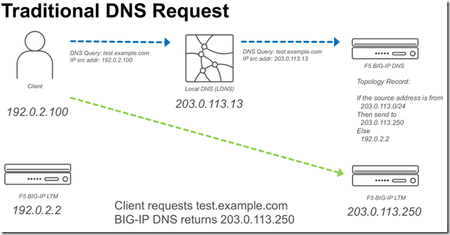
BIG-IP DNS 14.0 now supports edns-client-subnet (ECS) for both responding to client requests (GSLB) or forwarding client requests (screening). The following is a quick start on using this feature. What is EDNS-Client-Subnet (ECS) If you are familiar with X-Forwarded-For headers in HTTP requests, ECS solves a similar problem. The problem is how to forward a DNS request through a proxy and preserve information about the original request (IP Address). Some of this discussion I also cover in a previous article,Implementing Client Subnet in DNS Requests . Traditional DNS Requests When a traditional DNS request is made, a client makes a request to a “local” DNS server (LDNS), and that request is forwarded to the authoritative DNS server for that domain. When a topology (send different responses based on the source address) record is evaluated it will use the source IP of the LDNS server. Usually this is OK for most applications, but it would be ideal to be able to forward more precise information from the LDNS server. ECS DNS Requests Using ECS a LDNS server can inject additional meta-data about the request that includes information about the source IP address of the client. In the following example a “Client Subnet” of 192.0.2.0/24 is forwarded to the DNS server. ECS on BIG-IP DNS F5 BIG-IP DNS can use ECS in two ways. Use ECS when handling topology requests Inject ECS when “screening” a DNS server Using ECS with BIG-IP DNS Topology There are two methods of configuring BIG-IP DNS to use ECS. Either at the wide-ip or globally. To configure ECS on a wide-ip: To configure ECS globally. Under DNS Settings. Injecting ECS records BIG-IP DNS can also proxy requests to other DNS servers (BIG-IP DNS or other vendors). When you modify the DNS profile to insert an ECS record. You will observe that the original /32 address will be forwarded to any DNS servers that are in the pool for that particular Virtual Server. The following is a diagram of the above.14KViews2likes28CommentsPost of the Week: iControl REST Subcollections & ZoneRunner Options
In this episode of Post of the Week, Jason addresses a couple iControl REST issues that come up in Q&A often: confusion over how to handle objects that are not sub-collections, and options for working around the lack of F5 DNS cli for ZoneRunner. The procedures for safely updating the BIG-IP named files are covered in knowledge base article K7032 on AskF5.993Views0likes1CommentIs there a way to insert a HOST header in an HTTP 1.1 health monitor request?
I'm trying to create an HTTPS health monitor that verifies the same URL path (to an image file) for multiple pools. I'm trying to find a way to insert a host header of the pool members IPs being monitored. This is simply an attempt to create a generic health check that can be applied to many pools. HTTP 1.1 requests require a HOST header. A null value (Host: ) is valid unless the HTTP server requires them for virtual hosting, which is the case. FQDN of the virtual servers should not be used in this case because they are WideIPs (BIG-IP DNS) for datacenter failover services. Both virtual server and pool listen ports are HTTPS. Leaving HOST header blank does not work: GET /path/image.svg HTTP/1.1\r\nHost: \r\nConnection: Close\r\n\r\n Is there a way to insert the pool member IP in the GET? GET /path/image.svg HTTP/1.1\r\nHost: \r\nConnection: Close\r\n\r\n Of course, this would have to work for multiple pool members. I don't think there is an easy way to accomplish this within the health monitor, but worth asking. Worst case, I have to create unique health monitors for each pool using the virtual server IP in the HOST header.Solved2KViews0likes3Comments
F5 Whatsapp group move to Telegram
Good day, I hope someone can assist. There was a note out a while back regarding an F5 Whatsapp group. Shortly thereafter a response stated the group was full. The next response stated was going to move to Telegram. Just wanting to know if the group setup utilizing Telegram happened and if so, if someone could advise how to find/join the group. Cheers Paul3KViews0likes8CommentsUsing BIG-IP GTM to Integrate with Amazon Web Services
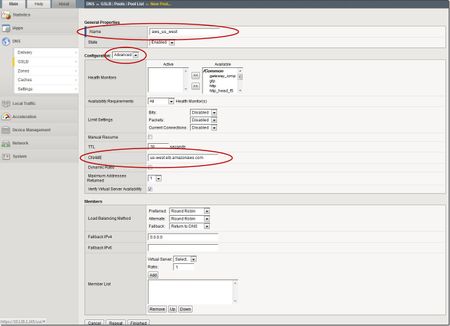
This is the latest in a series of DNS articles that I've been writing over the past couple of months. This article is taken from a fantastic solution that Joe Cassidy developed. So, thanks to Joe for developing this solution, and thanks for the opportunity to write about it here on DevCentral. As a quick reminder, my first six articles are: Let's Talk DNS on DevCentral DNS The F5 Way: A Paradigm Shift DNS Express and Zone Transfers The BIG-IP GTM: Configuring DNSSEC DNS on the BIG-IP: IPv6 to IPv4 Translation DNS Caching The Scenario Let's say you are an F5 customer who has external GTMs and LTMs in your environment, but you are not leveraging them for your main website (example.com). Your website is a zone sitting on your windows DNS servers in your DMZ that round robin load balance to some backend webservers. You've heard all about the benefits of the cloud (and rightfully so), and you want to move your web content to the Amazon Cloud. Nice choice! As you were making the move to Amazon, you were given instructions by Amazon to just CNAME your domain to two unique Amazon Elastic Load Balanced (ELB) domains. Amazon’s requests were not feasible for a few reasons...one of which is that it breaks the RFC. So, you engage in a series of architecture meetings to figure all this stuff out. Amazon told your Active Directory/DNS team to CNAME www.example.com and example.com to two AWS clusters: us-east.elb.amazonaws.com and us-west.elb.amazonaws.com. You couldn't use Microsoft DNS to perform a basic CNAME of these records because of the BIND limitation of CNAME'ing a single A record to multiple aliases. Additionally, you couldn't point to IPs because Amazon said they will be using dynamic IPs for your platform. So, what to do, right? The Solution The good news is that you can use the functionality and flexibility of your F5 technology to easily solve this problem. Here are a few steps that will guide you through this specific scenario: Redirect requests for http://example.com to http://www.example.com and apply it to your Virtual Server (1.2.3.4:80). You can redirect using HTTP Class profiles (v11.3 and prior) or using a policy with Centralized Policy Matching (v11.4 and newer) or you can always write an iRule to redirect! Make www.example.com a CNAME record to example.lb.example.com; where *.lb.example.com is a sub-delegated zone of example.com that resides on your BIG-IP GTM. Create a global traffic pool “aws_us_east” that contains no members but rather a CNAME to us-east.elb.amazonaws.com. Create another global traffic pool “aws_us_west” that contains no members but rather a CNAME to us-west.elb.amazonaws.com. The following screenshot shows the details of creating the global traffic pools (using v11.5). Notice you have to select the "Advanced" configuration to add the CNAME. Create a global traffic Wide IP example.lb.example.com with two pool members “aws_us_east” and “aws_us_west”. The following screenshot shows the details. Create two global traffic regions: “eastern” and “western”. The screenshot below shows the details of creating the traffic regions. Create global traffic topology records using "Request Source: Region is eastern" and "Destination Pool is aws_us_east". Repeat this for the western region using the aws_us_west pool. The screenshot below shows the details of creating these records. Modify Pool settings under Wide IP www.example.com to use "Topology" as load balancing method. See the screenshot below for details. How it all works... Here's the flow of events that take place as a user types in the web address and ultimately receives the correct IP address. External client types http://example.com into their web browser Internet DNS resolution takes place and maps example.com to your Virtual Server address: IN A 1.2.3.4 An HTTP request is directed to 1.2.3.4:80 Your LTM checks for a profile, the HTTP profile is enabled, the redirect request is applied, and redirect user request with 301 response code is executed External client receives 301 response code and their browser makes a new request to http://www.example.com Internet DNS resolution takes place and maps www.example.com to IN CNAME example.lb.example.com Internet DNS resolution continues mapping example.lb.example.com to your GTM configured Wide IP The Wide IP load balances the request to one of the pools based on the configured logic: Round Robin, Global Availability, Topology or Ratio (we chose "Topology" for our solution) The GTM-configured pool contains a CNAME to either us_east or us_west AWS data centers Internet DNS resolution takes place mapping the request to the ELB hostname (i.e. us-west.elb.amazonaws.com) and gives two A records External client http request is mapped to one of the returned IP addresses And, there you have it. With this solution, you can integrate AWS using your existing LTM and GTM technology! I hope this helps, and I hope you can implement this and other solutions using all the flexibility and power of your F5 technology.3.9KViews1like14Comments
GTM return LDNS IP to client
Problem this snippet solves: We do a lot of our load balancing based on topology rules, so it's often very useful to know where the DNS request is actually coming from rather than just the client's IP and the DNS servers they have configured. Especially if they're behind an ADSL router doing NAT or some other similar set up. This rule simply returns the IP address of the LDNS that eventually made the query to the GTM device in the response to a lookup for the WideIP using the rule, as well as logging the response and perceived location. Code : rule "DNS_debug" partition "Common" { when DNS_REQUEST { host [IP::client_addr] log local0.err "Debug address : [IP::client_addr] [whereis [IP::client_addr]]" } }1.2KViews1like2Comments