Rate Pace To Reduce Packet Loss
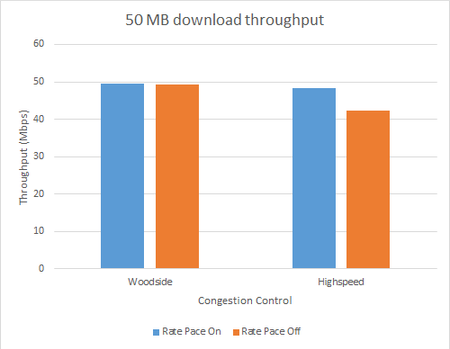
Rate Pace is a TCP Express™ feature that you should be using. Most TCP profile options have difficult tradeoffs. When we introduced Rate Pace in F5® TMOS® 11.5.0, it was unquestionably better for thr...
Published Jun 03, 2016
Version 1.0
Martin_Duke
I work in the Office of the CTO on both F5's standards engagement process in general, and specifically on the application of transport-layer innovation to F5's product line. F5 sponsors my service as Transport Area Director at the Internet Engineering Task Force (IETF), where I help to administer standards development worldwide.Ret. Employee

Martin_Duke
Sep 13, 2016Ret. Employee
"Congestion" isn't a binary state; in fact, a large-enough TCP flow will self-congest its length with most congestion control algorithms.
However, the older rate pace functionality (without rate-pace-max-rate) does what you describe. It uses the first packet loss (i.e. congestion event) to estimate the bandwidth and pace accordingly.
The purpose of rate-pace-max-rate is to avoid nonsense sending rates that exceed the known bottleneck bandwidth. For instance, there is no point in sending at 1Gbps if all of the flows are going over 4G.