json
20 Topics
Infrastructure Architecture: Whitelisting with JSON and API Keys
Application delivery infrastructure can be a valuable partner in architecting solutions …. AJAX and JSON have changed the way in which we architect applications, especially with respect to their ascendancy to rule the realm of integration, i.e. the API. Policies are generally focused on the URI, which has effectively become the exposed interface to any given application function. It’s REST-ful, it’s service-oriented, and it works well. Because we’ve taken to leveraging the URI as a basic building block, as the entry-point into an application, it affords the opportunity to optimize architectures and make more efficient the use of compute power available for processing. This is an increasingly important point, as capacity has become a focal point around which cost and efficiency is measured. By offloading functions to other systems when possible, we are able to increase the useful processing capacity of an given application instance and ensure a higher ratio of valuable processing to resources is achieved. The ability of application delivery infrastructure to intercept, inspect, and manipulate the exchange of data between client and server should not be underestimated. A full-proxy based infrastructure component can provide valuable services to the application architect that can enhance the performance and reliability of applications while abstracting functionality in a way that alleviates the need to modify applications to support new initiatives. AN EXAMPLE Consider, for example, a business requirement specifying that only certain authorized partners (in the integration sense) are allowed to retrieve certain dynamic content via an exposed application API. There are myriad ways in which such a requirement could be implemented, including requiring authentication and subsequent tokens to authorize access – likely the most common means of providing such access management in conjunction with an API. Most of these options require several steps, however, and interaction directly with the application to examine credentials and determine authorization to requested resources. This consumes valuable compute that could otherwise be used to serve requests. An alternative approach would be to provide authorized consumers with a more standards-based method of access that includes, in the request, the very means by which authorization can be determined. Taking a lesson from the credit card industry, for example, an algorithm can be used to determine the validity of a particular customer ID or authorization token. An API key, if you will, that is not stored in a database (and thus requires a lookup) but rather is algorithmic and therefore able to be verified as valid without needing a specific lookup at run-time. Assuming such a token or API key were embedded in the URI, the application delivery service can then extract the key, verify its authenticity using an algorithm, and subsequently allow or deny access based on the result. This architecture is based on the premise that the application delivery service is capable of responding with the appropriate JSON in the event that the API key is determined to be invalid. Such a service must therefore be network-side scripting capable. Assuming such a platform exists, one can easily implement this architecture and enjoy the improved capacity and resulting performance boost from the offload of authorization and access management functions to the infrastructure. 1. A request is received by the application delivery service. 2. The application delivery service extracts the API key from the URI and determines validity. 3. If the API key is not legitimate, a JSON-encoded response is returned. 4. If the API key is valid, the request is passed on to the appropriate web/application server for processing. Such an approach can also be used to enable or disable functionality within an application, including live-streams. Assume a site that serves up streaming content, but only to authorized (registered) users. When requests for that content arrive, the application delivery service can dynamically determine, using an embedded key or some portion of the URI, whether to serve up the content or not. If it deems the request invalid, it can return a JSON response that effectively “turns off” the streaming content, thereby eliminating the ability of non-registered (or non-paying) customers to access live content. Such an approach could also be useful in the event of a service failure; if content is not available, the application delivery service can easily turn off and/or respond to the request, providing feedback to the user that is valuable in reducing their frustration with AJAX-enabled sites that too often simply “stop working” without any kind of feedback or message to the end user. The application delivery service could, of course, perform other actions based on the in/validity of the request, such as directing the request be fulfilled by a service generating older or non-dynamic streaming content, using its ability to perform application level routing. The possibilities are quite extensive and implementation depends entirely on goals and requirements to be met. Such features become more appealing when they are, through their capabilities, able to intelligently make use of resources in various locations. Cloud-hosted services may be more or less desirable for use in an application, and thus leveraging application delivery services to either enable or reduce the traffic sent to such services may be financially and operationally beneficial. ARCHITECTURE is KEY The core principle to remember here is that ultimately infrastructure architecture plays (or can and should play) a vital role in designing and deploying applications today. With the increasing interest and use of cloud computing and APIs, it is rapidly becoming necessary to leverage resources and services external to the application as a means to rapidly deploy new functionality and support for new features. The abstraction offered by application delivery services provides an effective, cross-site and cross-application means of enabling what were once application-only services within the infrastructure. This abstraction and service-oriented approach reduces the burden on the application as well as its developers. The application delivery service is almost always the first service in the oft-times lengthy chain of services required to respond to a client’s request. Leveraging its capabilities to inspect and manipulate as well as route and respond to those requests allows architects to formulate new strategies and ways to provide their own services, as well as leveraging existing and integrated resources for maximum efficiency, with minimal effort. Related blogs & articles: HTML5 Going Like Gangbusters But Will Anyone Notice? Web 2.0 Killed the Middleware Star The Inevitable Eventual Consistency of Cloud Computing Let’s Face It: PaaS is Just SOA for Platforms Without the Baggage Cloud-Tiered Architectural Models are Bad Except When They Aren’t The Database Tier is Not Elastic The New Distribution of The 3-Tiered Architecture Changes Everything Sessions, Sessions Everywhere3.2KViews0likes0Comments
Parsing complex BIG-IP json structures made easy with Ansible filters like json_query
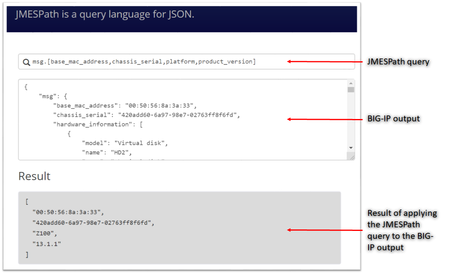
JMESPath and json_query JMESPath (JSON Matching Expression paths) is a query language for searching JSON documents. It allows you to declaratively extract elements from a JSON document. Have a look at this tutorial to learn more. The json_query filter lets you query a complex JSON structure and iterate over it using a loop structure.This filter is built upon jmespath, and you can use the same syntax as jmespath. Click here to learn more about the json_query filter and how it is used in Ansible. In this article we are going to use the bigip_device_info module to get various facts from the BIG-IP and then use the json_query filter to parse the output to extract relevant information. Ansible bigip_device_info module Playbook to query the BIG-IP and gather system based information. - name: "Get BIG-IP Facts" hosts: bigip gather_facts: false connection: local tasks: - name: Query BIG-IP facts bigip_device_info: provider: validate_certs: False server: "xxx.xxx.xxx.xxx" user: "*****" password: "*****" gather_subset: - system-info register: bigip_facts - set_fact: facts: '{{bigip_facts.system_info}}' - name: debug debug: msg="{{facts}}" To view the output on a different subset, below are a few examples to change the gather_subset and set_fact values in the above playbook from gather_subset: system-info, facts: bigip_facts.system_info to any of the below: gather_subset: vlans , facts: bigip_facts.vlans gather_subset: self-ips, facts: bigip_facts.self_ips gather_subset: nodes. facts: bigip_facts.nodes gather_subset: software-volumes, facts: bigip_facts.software_volumes gather_subset: virtual-servers, facts: bigip_facts.virtual_servers gather_subset: system-info, facts: bigip_facts.system_info gather_subset: ltm-pools, facts: bigip_facts.ltm_pools Click here to view all the information that can be obtained from the BIG-IP using this module. Parse the JSON output Once we have the output lets take a look at how to parse the output. As mentioned above the jmespath syntax can be used by the json_query filter. Step 1: We will get the jmespath syntax for the information we want to extract Step 2: We will see how the jmespath syntax and then be used with json_query in an Ansible playbook The website used in this article to try out the below syntax: https://jmespath.org/ Some BIG-IP sample outputs are attached to this article as well (Check the attachments section after the References). The attachment file is a combined output of a few configuration subsets.Copy paste the relevant information from the attachment to test the below examples if you do not have a BIG-IP. System information The output for this section is obtained with above playbook using parameters: gather_subset: system-info, facts: bigip_facts.system_info Once the above playbook is run against your BIG-IP or if you are using the sample configuration attached, copy the output and paste it in the relevant text box. Try different queries by placing them in the text box next to the magnifying glass as shown in image below # Get MAC address, serial number, version information msg.[base_mac_address,chassis_serial,platform,product_version] # Get MAC address, serial number, version information and hardware information msg.[base_mac_address,chassis_serial,platform,product_version,hardware_information[*].[name,type]] Software volumes The output for this section is obtained with above playbook using parameters: gather_subset: software-volumes facts: bigip_facts.software_volumes # Get the name and version of the software volumes installed and its status msg[*].[name,active,version] # Get the name and version only for the software volume that is active msg[?active=='yes'].[name,version] VLANs and Self-Ips The output for this section is obtained with above playbook using parameters gather_subset: vlans and self-ips facts: bigip_facts Look at the following example to define more than one subset in the playbook # Get all the self-ips addresses and vlans assigned to the self-ip # Also get all the vlans and the interfaces assigned to the vlan [msg.self_ips[*].[address,vlan], msg.vlans[*].[full_path,interfaces[*]]] Nodes The output for this section is obtained with above playbook using parameters gather_subset: nodes, facts: bigip_facts.nodes # Get the address and availability status of all the nodes msg[*].[address,availability_status] # Get availability status and reason for a particular node msg[?address=='192.0.1.101'].[full_path,availability_status,status_reason] Pools The output for this section is obtained with above playbook using parameters gather_subset: ltm-pools facts: bigip_facts.ltm_pools # Get the name of all pools msg[*].name # Get the name of all pools and their associated members msg[*].[name,members[*]] # Get the name of all pools and only address of their associated members msg[*].[name,members[*].address] # Get the name of all pools along with address and status of their associated members msg[*].[name,members[*].address,availability_status] # Get status of pool members of a particular pool msg[?name=='/Common/pool'].[members[*].address,availability_status] # Get status of pool # Get address, partition, state of pool members msg[*].[name,members[*][address,partition,state],availability_status] # Get status of a particular pool and particular member (multiple entries on a member) msg[?full_name=='/Common/pool'].[members[?address=='192.0.1.101'].[address,partition],availability_status] Virtual Servers The output for this section is obtained with above playbook using parameters gather_subset: virtual-servers facts: bigip_facts.virtual_servers # Get destination IP address of all virtual servers msg[*].destination # Get destination IP and default pool of all virtual servers msg[*].[destination,default_pool] # Get me all destination IP of all virtual servers that a particular pool as their default pool msg[?default_pool=='/Common/pool'].destination # Get me all profiles assigned to all virtual servers msg[*].[destination,profiles[*].name] Loop and display using Ansible We have seen how to use the jmespath syntax and extract information, now lets see how to use it within an Ansible playbook - name: Parse the output hosts: localhost connection: local gather_facts: false tasks: - name: Setup provider set_fact: provider: server: "xxx.xxx.xxx.xxx" user: "*****" password: "*****" server_port: "443" validate_certs: "no" - name: Query BIG-IP facts bigip_device_info: provider: "{{provider}}" gather_subset: - system_info register: bigip_facts - debug: msg="{{bigip_facts.system_info}}" # Use json query filter. The query_string will be the jmespath syntax # From the jmespath query remove the 'msg' expression and use it as it is - name: "Show relevant information" set_fact: result: "{{bigip_facts.system_info | json_query(query_string)}}" vars: query_string: "[base_mac_address,chassis_serial,platform,product_version,hardware_information[*].[name,type]]" - debug: "msg={{result}}" Another example of what would change if you use a different query (only highlighting the changes that need to made below from the entire playbook) - name: Query BIG-IP facts bigip_device_info: provider: "{{provider}}" gather_subset: - ltm-pools register: bigip_facts - debug: msg="{{bigip_facts.ltm_pools}}" - name: "Show relevant information" set_fact: result: "{{bigip_facts.ltm_pools | json_query(query_string)}}" vars: query_string: "[*].[name,members[*][address,partition,state],availability_status]" The key is to get the jmespath syntax for the information you are looking for and then its a simple step to incorporate it within your Ansible playbook References Try the queries - https://jmespath.org/ Learn more jmespath syntax and example - https://jmespath.org/tutorial.html Ansible lab that can be used as a sandbox - https://clouddocs.f5.com/training/automation-sandbox/2.8KViews2likes2CommentsThe Stealthy Ascendancy of JSON
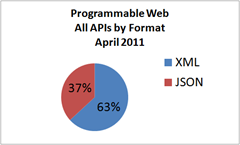
While everyone was focused on cloud, JSON has slowly but surely been taking over the application development world It looks like the debate between XML and JSON may be coming to a close with JSON poised to take the title of preferred format for web applications. If you don’t consider these statistics to be impressive, consider that ProgrammableWeb indicated that its “own statistics on ProgrammableWeb show a significant increase in the number of JSON APIs over 2009/2010. During 2009 there were only 191 JSON APIs registered. So far in 2010 [August] there are already 223!” Today there are 1262 JSON APIs registered, which means a growth rate of 565% in the past eight months, nearly catching up to XML which currently lists 2162 APIs. At this rate, JSON will likely overtake XML as the preferred format by the end of 2011. This is significant to both infrastructure vendors and cloud computing providers alike, because it indicates a preference for a programmatic model that must be accounted for when developing services, particularly those in the PaaS (Platform as a Service) domain. PaaS has yet to grab developers mindshare and it may be that support for JSON will be one of the ways in which that mindshare is attracted. Consider the results of the “State of Web Development 2010” survey from Web Directions in which developers were asked about their cloud computing usage; only 22% responded in the affirmative to utilizing cloud computing. But of those 22% that do leverage cloud computing, the providers they use are telling: PaaS represents a mere 7.35% of developers use of cloud computing, with storage (Amazon S3) and IaaS (Infrastructure as a Service) garnering 26.89% of responses. Google App Engine is the dominant PaaS platform at the moment, most likely owing to the fact that it is primarily focused on JavaScript, UI, and other utility-style services as opposed to Azure’s middle-ware and definitely more enterprise-class focused services. SaaS, too, is failing to recognize the demand from developers and the growing ascendancy of JSON. Consider this exchange on the Salesforce.com forums regarding JSON. Come on salesforce lets get this done. We need to integrate, we need this [JSON]. If JSON continues its steady rise into ascendancy, PaaS and SaaS providers alike should be ready to support JSON-style integration as its growth pattern indicates it is not going away, but is instead picking up steam. Providers able to support JSON for PaaS and SaaS will have a competitive advantage over those that do not, especially as they vie for the hearts and minds of developers which are, after all, their core constituency. THE IMPACT What the steady rise of JSON should trigger for providers and vendors alike is a need to support JSON as the means by which services are integrated, invoked, and data exchanged. Application delivery, service-providers and Infrastructure 2.0 focused solutions need to provide APIs that are JSON compatible and which are capable of handling the format to provide core infrastructure services such as firewalling and data scrubbing duties. The increasing use of JSON-based APIs to integrate with external, third-party services continues to grow and the demand for enterprise-class service to support JSON as well will continue to rise. There are drawbacks, and this steady movement toward JSON has in some cases a profound impact on the infrastructure and architectural choices made by IT organizations, especially in terms of providing for consistency of services across what is likely a very mixed-format environment. Identity and access management and security services may not be prepared to handle JSON APIs nor provide the same services as it has for XML, which through long established usage and efforts comes with its own set of standards. Including social networking “streams” in applications and web-sites is now as common as including images, but changes to APIs may make basic security chores difficult. Consider that Twitter – very quietly – has moved to supporting JSON only for its Streaming API. Organizations that were, as well they should, scrubbing such streams to prevent both embarrassing as well as malicious code from being integrated unknowingly into their sites, may have suddenly found that infrastructure providing such services no longer worked: API providers and developers are making their choice quite clear when it comes to choosing between XML and JSON. A nearly unanimous choice seems to be JSON. Several API providers, including Twitter, have either stopped supporting the XML format or are even introducing newer versions of their API with only JSON support. In our ProgrammableWeb API directory, JSON seems to be the winner. A couple of items are of interest this week in the XML versus JSON debate. We had earlier reported that come early December, Twitter plans to stop support for XML in its Streaming API. --JSON Continues its Winning Streak Over XML, ProgrammableWeb (Dec 2010) Similarly, caching and acceleration services may be confused by a change from XML to JSON; from a format that was well-understood and for which solutions were enabled with parsing capabilities to one that is not. IT’S THE DATA, NOT the API The fight between JSON and XML is one we continue to see in a general sense. See, it isn’t necessarily the API that matters, in the end, but the data format (the semantics) used to exchange that data which matters. XML is considered unstructured, though in practice it’s far more structured than JSON in the sense that there are meta-data standards for XML that constrain security, identity, and even application formats. JSON, however, although having been included natively in ECMA v5 (JSON data interchange format gets ECMA standards blessing) has very few standards aside from those imposed by frameworks and toolkits such as JQuery. This will make it challenging for infrastructure vendors to support services targeting application data – data scrubbing, web application firewall, IDS, IPS, caching, advanced routing – to continue to effectively deliver such applications without recognizing JSON as an option. The API has become little more than a set of URIs and nearly all infrastructure directly related to application delivery is more than capable of handling them. It is the data, however, that presents a challenge and which makes the developers’ choice of formats so important in the big picture. It isn’t just the application and integration that is impacted, it’s the entire infrastructure and architecture that must adapt to support the data format. The World Doesn’t Care About APIs – but it does care about the data, about the model. Right now, it appears that model is more than likely going to be presented in a JSON-encoded format. JSON data interchange format gets ECMA standards blessing JSON Continues its Winning Streak Over XML JSON versus XML: Your Choice Matters More Than You Think I am in your HTTP headers, attacking your application The Web 2.0 API: From collaborating to compromised Would you risk $31,000 for milliseconds of application response time? Stop brute force listing of HTTP OPTIONS with network-side scripting The New Distribution of The 3-Tiered Architecture Changes Everything Are You Scrubbing the Twitter Stream on Your Web Site?1.1KViews0likes0Comments
F5 SSLO Unified Configuration API Quick Introduction
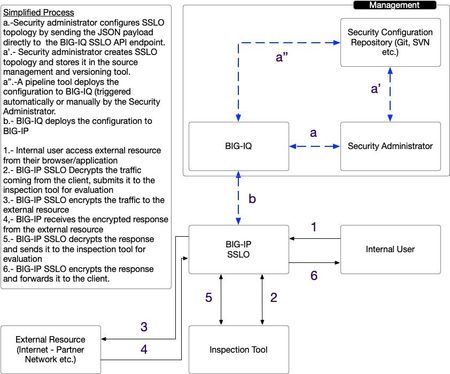
Introduction Prior to the introduction of BIG-IQ 8.0, you had to use the BIG-IQ graphical user interface (GUI) to configure F5 SSL Orchestrator (SSLO) Topologies and their dependencies. Starting with BIG-IQ 8.0, a new REST unified, supported and documented REST API endpoint was created to simplify SSLO configuration workflows. The aim is to simplify the configuration of F5 SSLO using standardized API calls. You are now able to store the configuration in your versioning tool (Git, SVN, etc.), and easily integrate the configuration of F5 SSLO in your automation and pipeline tools. For more information about F5 SSLO, please refer to this introductory video. An overview of F5 SSL Orchestrator is provided in K1174564. As a reminder the BIG-IQ API reference documentation can be found here. Documentation for the Access Simplified Workflow can be found here. The figure below shows a possible use for the SSLO Unified API. A few shortcuts are taken in the figure above as it is meant to illustrate the advantage of the simplified workflow. Example Configuration For the configuration the administrator needs to: -Create a JSON blurb or payload that will be sent to the BIG-IQ API -Authenticate to the BIG-IQ API -Send the payload to the BIG-IQ -Ensure that the workflow completes successfully The following aims to provide a step-by-step configuration of SSLO leveraging the API. In practice, the steps may be automated and may be included in the pipeline used to deploy the application leveraging the enterprise tooling and processes in place. 1.- Authenticate to the API API interactions with the BIG-IQ API requires the use of a token. The initial REST call should look like the following: REST Endpoint : /mgmt/shared/authn/login HTTP Method: POST Headers: -content-type: application/json Content: { "username": "", "password": "", "loginProviderName": "" } Example: POST https://10.0.0.1/mgmt/shared/authn/login HTTP/1.1 Headers: content-type: application/json Content: { "username": "username", "password": "complicatedPassword!", "loginProviderName": "RadiusServer" } The call above will authenticate the user “bob” to the API. The result of a successful authentication is the response from the BIG-IQ API with a token. 2.- Push the configuration to BIG-IQ The headers and HTTP request should look like the following: URI: mgmt/cm/sslo/api/topology HTTP Method: POST Headers: -content-type: application/json -X-F5-Auth-Token: [token obtained from the authentication process above] To send the configuration to the BIG-IQ you will need to send the following payload - the blurb is cut up in smaller pieces for readability. The JSON blurb is divided in multiple parts - the full concatenated text is available in the file in attachment. Start by defining an new topology with the following characteristics: Name: "sslo_NewTopology" Listening on the "/Common/VLAN_TRAP" VLAN The topology is of type "topology_l3_outbound" The SSL settings defined below named: "ssloT_NewSsl_Dec" The policy is called: "ssloP_NewPolicy_Dec" The JSON payload starts with the following: { "template": { "TOPOLOGY": { "name": "sslo_NewTopology ", "ingressNetwork": { "vlans": [ { "name": "/Common/VLAN_TAP" } ] }, "type": "topology_l3_outbound", "sslSetting": "ssloT_NewSsl_Dec", "securityPolicy": "ssloP_NewPolicy_Dec" }, The SSL settings used above are defined in the following JSON that creates a new profile with default values: "SSL_SETTINGS": { "name": "ssloT_NewSsl_Dec" }, The security policy is configured as follows: name: ssloP_NewPolicy_Dec function: introduces a pinning policy doing a policy lookup - matching requests are bypassed (no ssl decryp) with the associated service chain "ssloSC_NewServiceChain_Dec" that is defined further down below. "SECURITY_POLICY": { "name": "ssloP_NewPolicy_Dec", "rules": [ { "mode": "edit", "name": "Pinners_Rule", "action": "allow", "operation": "AND", "conditions": [ { "type": "SNI Category Lookup", "options": { "category": [ "Pinners" ] } }, { "type": "SSL Check", "options": { "ssl": true } } ], "actionOptions": { "ssl": "bypass", "serviceChain": "ssloSC_NewServiceChain_Dec" } }, { "mode": "edit", "name": "All Traffic", "action": "allow", "isDefault": true, "operation": "AND", "actionOptions": { "ssl": "intercept" } } ] }, The service chain configuration is defined below to forward the traffic to the "ssloS_ICAP_Dec" service. this is done with the following JSON: "SERVICE_CHAIN": { "ssloSC_NewServiceChain_Declarative": { "name": "ssloSC_NewServiceChain_Dec", "orderedServiceList": [ { "name":"ssloS_ICAP_Dec" } ] } }, The "ssloS_ICAP_Dec" service is defined with the JSON below with IP 3.3.3.3 on port 1344 "SERVICE": { "ssloS_ICAP_Declarative": { "name": "ssloS_ICAP_Dec", "customService": { "name": "ssloS_ICAP_Dec", "serviceType": "icap", "loadBalancing": { "devices": [ { "ip": "3.3.3.3", "port": "1344" } ] } } } } }, The configuration will be deployed to the target defined below: "targetList": [ { "type": "DEVICE", "name": "my.bigip.internal" } ] } After the HTTP POST, the BIG-IQ will respond with a transaction id. A sample of what looks like is given below: { […] "id":"edc17b06-8d97-47e1-9a78-3d47d2db70a6", "status":"STARTED", […] } You can check on the status of the deployment task by submitting a request as follows: -HTTP GET Method -Authenticated with the use of the custom authentication header X-F5-Auth-Token -Sent to the BIG-IQ to URI GET mgmt/cm/sslo/tasks/api/{{status_id}} HTTP/1.1 -With Content-Type header set to: Application/JSON Once the status of the task changes to FINISHED. The configuration is successfully completed. You can now check the F5 SSLO interface to make sure the new topology has been created. The BIG-IQ interface will show the new topology as depicted in the example below: The new topology has been deployed to the BIG-IP automatically. You can connect to the BIG-IP to verify, the interface should like the one depicted below: Congratulations, you now have successfully deployed a fully functional topology that your users can start using. Note that, you can also use the BIG-IQ REST API to delete the items that were just created. This is done by sending HTTP DELETE to the different API endpoints for the topology, service, security profile etc. For example, for the example above, you would be sending HTTP DELETE requests to the following URI’s: - For the topology: /mgmt/cm/sslo/api/topology/sslo_NewTopology_Dec - For the service chain: /mgmt/cm/sslo/api/service-chain/ssloSC_NewServiceChain_Dec - For the ICAP service: /mgmt/cm/sslo/api/ssl/ssloT_NewSsl_Dec All the requests listed above need to be sent to the BIG-IQ system to its management IP address with the following 2 headers: - content-type: application/json - X-F5-Auth-Token: [value of the authentication token obtained during authentication] Conclusion BIG-IQ makes it easier to manage SSLO Topologies thanks to its REST API. You can now make supported, standardized API calls to the BIG-IQ to create and modify topologies and deploy the changes directly to BIG-IP.862Views1like0CommentsWorking with iControl REST Data on the Command Line
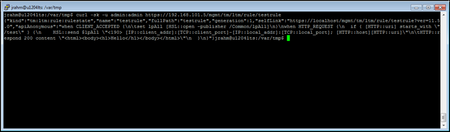
I'm still pretty entrenched in "old school" iControl with the soap interface, but with Colin's new series on the iControl REST interface underway, I thought I'd start taking more than a glance. While Colin's sed-fu in his latest article is impressive, I want to see the json data returned from iControl REST calls parsed properly (no offense, Colin!) This can be done with any number of bash, perl, python, and more tools, but I ran across one on twitter last night that is somewhat magical. jq is a single binary you can download and it just works. So why bother? Well, as Colin pointed out, the returned json data (by default) is none too fabulous in format: But with jq, you get nice pretty text with field callouts (jq .): But wait! There's more! You can also narrow the selection to the fields you want (jq '{ name, apiAnonymous }'): If you want to pull all the rules together, but still only return the name and code, just index by item (jq '.items[] | { name, partition, apiAnonymous }'):699Views0likes2CommentsSOAP vs REST: The war between simplicity and standards
SOA is, at its core, a design and development methodology. It embraces reuse through decomposition of business processes and functions into core services. It enables agility by wrapping services in an accessible interface that is decoupled from its implementation. It provides a standard mechanism for application integration that can be used internally or externally. It is, as they say, what it is. SOA is not necessarily SOAP, though until the recent rise of social networking and Web 2.0 there was little real competition against the rising standard. But of late the adoption of REST and its use on the web facing side of applications has begun to push around the incumbent. We still aren't sure who swung first. We may never know, and at this point it's irrelevant: there's a war out there, as SOAP and REST duke it out for dominance of SOA. At the core of the argument is this: SOAP is weighted down by the very standards designed to promote interoperability (WS-I), security (WS-Security), and reliability (WS-Reliability). REST is a lightweight compared to its competitor, with no standards at all. Simplicity is its siren call, and it's being heard even in the far corners of corporate data centers. A February 2007 Evans Data survey found a 37% increase in those implementing or considering REST, with 25% considering REST-Based Web Services as a simpler alternative to SOAP-based services. And that was last year, before social networking really exploded and the integration of Web 2.0 sites via REST-based services took over the face of the Internet. It was postulated then that WOA (Web Oriented Architecture) was the face of SOA (Service Oriented Architecture). That REST on the outside was the way to go, but SOAP on the inside was nearly sacrosanct. Apparently that thought, while not wrong in theory, didn't take into account the fervor with which developers hold dear their beliefs regarding everything from language to operating system to architecture. The downturn in the economy hasn't helped, either, as REST certainly is easier and faster to implement, even with the plethora of development tools and environments available to carry all the complex WS-* standards that go along with SOAP like some sort of technology bellhop. Developers have turned to the standard-less option because it seems faster, cheaper, and easier. And honestly, we really don't like being told how to do things. I don't, and didn't, back in the day when the holy war was between structured and object-oriented programming. While REST has its advantages, certainly, standard-less development can, in the long-run, be much more expensive to maintain and manage than standards-focused competing architectures. The argument that standards-based protocols and architectures is difficult because there's more investment required to learn the basics as well as associated standards is essentially a red herring. Without standards there is often just as much investment in learning data formats (are you using XML? JSON? CSV? Proprietary formats? WWW-URL encoded?) as there is in learning standards. Without standards there is necessarily more documentation required, which cuts into development time. Then there's testing. Functional and vulnerability testing which necessarily has to be customized because testing tools can't predict what format or protocol you might be using. And let's not forget the horror that is integration, and how proprietary application protocols made it a booming software industry replete with toolkits and libraries and third-party packages just to get two applications to play nice together. Conversely, standards that are confusing and complex lengthen the implementation cycle, but make integration and testing as well as long term maintenance much less painful and less costly. Arguing simplicity versus standards is ridiculous in the war between REST and SOA because simplicity without standards is just as detrimental to the costs and manageability of an application as is standards without simplicity. Related articles by Zemanta RESTful .NET Has social computing changed attitudes toward reuse? The death of SOA has been greatly exaggerated Web 2.0: Integration, APIs, and scalability Performance Impact: Granularity of Services647Views0likes3Comments5 Years Later: OpenAJAX Who?
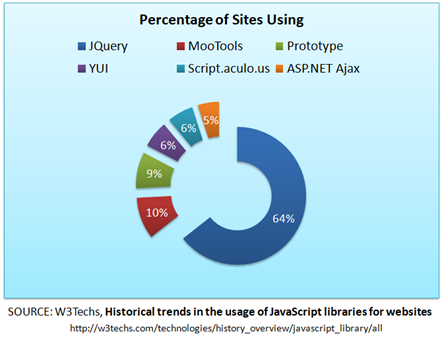
Five years ago the OpenAjax Alliance was founded with the intention of providing interoperability between what was quickly becoming a morass of AJAX-based libraries and APIs. Where is it today, and why has it failed to achieve more prominence? I stumbled recently over a nearly five year old article I wrote in 2006 for Network Computing on the OpenAjax initiative. Remember, AJAX and Web 2.0 were just coming of age then, and mentions of Web 2.0 or AJAX were much like that of “cloud” today. You couldn’t turn around without hearing someone promoting their solution by associating with Web 2.0 or AJAX. After reading the opening paragraph I remembered clearly writing the article and being skeptical, even then, of what impact such an alliance would have on the industry. Being a developer by trade I’m well aware of how impactful “standards” and “specifications” really are in the real world, but the problem – interoperability across a growing field of JavaScript libraries – seemed at the time real and imminent, so there was a need for someone to address it before it completely got out of hand. With the OpenAjax Alliance comes the possibility for a unified language, as well as a set of APIs, on which developers could easily implement dynamic Web applications. A unified toolkit would offer consistency in a market that has myriad Ajax-based technologies in play, providing the enterprise with a broader pool of developers able to offer long term support for applications and a stable base on which to build applications. As is the case with many fledgling technologies, one toolkit will become the standard—whether through a standards body or by de facto adoption—and Dojo is one of the favored entrants in the race to become that standard. -- AJAX-based Dojo Toolkit , Network Computing, Oct 2006 The goal was simple: interoperability. The way in which the alliance went about achieving that goal, however, may have something to do with its lackluster performance lo these past five years and its descent into obscurity. 5 YEAR ACCOMPLISHMENTS of the OPENAJAX ALLIANCE The OpenAjax Alliance members have not been idle. They have published several very complete and well-defined specifications including one “industry standard”: OpenAjax Metadata. OpenAjax Hub The OpenAjax Hub is a set of standard JavaScript functionality defined by the OpenAjax Alliance that addresses key interoperability and security issues that arise when multiple Ajax libraries and/or components are used within the same web page. (OpenAjax Hub 2.0 Specification) OpenAjax Metadata OpenAjax Metadata represents a set of industry-standard metadata defined by the OpenAjax Alliance that enhances interoperability across Ajax toolkits and Ajax products (OpenAjax Metadata 1.0 Specification) OpenAjax Metadata defines Ajax industry standards for an XML format that describes the JavaScript APIs and widgets found within Ajax toolkits. (OpenAjax Alliance Recent News) It is interesting to see the calling out of XML as the format of choice on the OpenAjax Metadata (OAM) specification given the recent rise to ascendancy of JSON as the preferred format for developers for APIs. Granted, when the alliance was formed XML was all the rage and it was believed it would be the dominant format for quite some time given the popularity of similar technological models such as SOA, but still – the reliance on XML while the plurality of developers race to JSON may provide some insight on why OpenAjax has received very little notice since its inception. Ignoring the XML factor (which undoubtedly is a fairly impactful one) there is still the matter of how the alliance chose to address run-time interoperability with OpenAjax Hub (OAH) – a hub. A publish-subscribe hub, to be more precise, in which OAH mediates for various toolkits on the same page. Don summed it up nicely during a discussion on the topic: it’s page-level integration. This is a very different approach to the problem than it first appeared the alliance would take. The article on the alliance and its intended purpose five years ago clearly indicate where I thought this was going – and where it should go: an industry standard model and/or set of APIs to which other toolkit developers would design and write such that the interface (the method calls) would be unified across all toolkits while the implementation would remain whatever the toolkit designers desired. I was clearly under the influence of SOA and its decouple everything premise. Come to think of it, I still am, because interoperability assumes such a model – always has, likely always will. Even in the network, at the IP layer, we have standardized interfaces with vendor implementation being decoupled and completely different at the code base. An Ethernet header is always in a specified format, and it is that standardized interface that makes the Net go over, under, around and through the various routers and switches and components that make up the Internets with alacrity. Routing problems today are caused by human error in configuration or failure – never incompatibility in form or function. Neither specification has really taken that direction. OAM – as previously noted – standardizes on XML and is primarily used to describe APIs and components - it isn’t an API or model itself. The Alliance wiki describes the specification: “The primary target consumers of OpenAjax Metadata 1.0 are software products, particularly Web page developer tools targeting Ajax developers.” Very few software products have implemented support for OAM. IBM, a key player in the Alliance, leverages the OpenAjax Hub for secure mashup development and also implements OAM in several of its products, including Rational Application Developer (RAD) and IBM Mashup Center. Eclipse also includes support for OAM, as does Adobe Dreamweaver CS4. The IDE working group has developed an open source set of tools based on OAM, but what appears to be missing is adoption of OAM by producers of favored toolkits such as jQuery, Prototype and MooTools. Doing so would certainly make development of AJAX-based applications within development environments much simpler and more consistent, but it does not appear to gaining widespread support or mindshare despite IBM’s efforts. The focus of the OpenAjax interoperability efforts appears to be on a hub / integration method of interoperability, one that is certainly not in line with reality. While certainly developers may at times combine JavaScript libraries to build the rich, interactive interfaces demanded by consumers of a Web 2.0 application, this is the exception and not the rule and the pub/sub basis of OpenAjax which implements a secondary event-driven framework seems overkill. Conflicts between libraries, performance issues with load-times dragged down by the inclusion of multiple files and simplicity tend to drive developers to a single library when possible (which is most of the time). It appears, simply, that the OpenAJAX Alliance – driven perhaps by active members for whom solutions providing integration and hub-based interoperability is typical (IBM, BEA (now Oracle), Microsoft and other enterprise heavyweights – has chosen a target in another field; one on which developers today are just not playing. It appears OpenAjax tried to bring an enterprise application integration (EAI) solution to a problem that didn’t – and likely won’t ever – exist. So it’s no surprise to discover that references to and activity from OpenAjax are nearly zero since 2009. Given the statistics showing the rise of JQuery – both as a percentage of site usage and developer usage – to the top of the JavaScript library heap, it appears that at least the prediction that “one toolkit will become the standard—whether through a standards body or by de facto adoption” was accurate. Of course, since that’s always the way it works in technology, it was kind of a sure bet, wasn’t it? WHY INFRASTRUCTURE SERVICE PROVIDERS and VENDORS CARE ABOUT DEVELOPER STANDARDS You might notice in the list of members of the OpenAJAX alliance several infrastructure vendors. Folks who produce application delivery controllers, switches and routers and security-focused solutions. This is not uncommon nor should it seem odd to the casual observer. All data flows, ultimately, through the network and thus, every component that might need to act in some way upon that data needs to be aware of and knowledgeable regarding the methods used by developers to perform such data exchanges. In the age of hyper-scalability and über security, it behooves infrastructure vendors – and increasingly cloud computing providers that offer infrastructure services – to be very aware of the methods and toolkits being used by developers to build applications. Applying security policies to JSON-encoded data, for example, requires very different techniques and skills than would be the case for XML-formatted data. AJAX-based applications, a.k.a. Web 2.0, requires different scalability patterns to achieve maximum performance and utilization of resources than is the case for traditional form-based, HTML applications. The type of content as well as the usage patterns for applications can dramatically impact the application delivery policies necessary to achieve operational and business objectives for that application. As developers standardize through selection and implementation of toolkits, vendors and providers can then begin to focus solutions specifically for those choices. Templates and policies geared toward optimizing and accelerating JQuery, for example, is possible and probable. Being able to provide pre-developed and tested security profiles specifically for JQuery, for example, reduces the time to deploy such applications in a production environment by eliminating the test and tweak cycle that occurs when applications are tossed over the wall to operations by developers. For example, the jQuery.ajax() documentation states: By default, Ajax requests are sent using the GET HTTP method. If the POST method is required, the method can be specified by setting a value for the type option. This option affects how the contents of the data option are sent to the server. POST data will always be transmitted to the server using UTF-8 charset, per the W3C XMLHTTPRequest standard. The data option can contain either a query string of the form key1=value1&key2=value2 , or a map of the form {key1: 'value1', key2: 'value2'} . If the latter form is used, the data is converted into a query string using jQuery.param() before it is sent. This processing can be circumvented by setting processData to false . The processing might be undesirable if you wish to send an XML object to the server; in this case, change the contentType option from application/x-www-form-urlencoded to a more appropriate MIME type. Web application firewalls that may be configured to detect exploitation of such data – attempts at SQL injection, for example – must be able to parse this data in order to make a determination regarding the legitimacy of the input. Similarly, application delivery controllers and load balancing services configured to perform application layer switching based on data values or submission URI will also need to be able to parse and act upon that data. That requires an understanding of how jQuery formats its data and what to expect, such that it can be parsed, interpreted and processed. By understanding jQuery – and other developer toolkits and standards used to exchange data – infrastructure service providers and vendors can more readily provide security and delivery policies tailored to those formats natively, which greatly reduces the impact of intermediate processing on performance while ensuring the secure, healthy delivery of applications.537Views0likes0CommentsWorking with JSON data in iRules - Part 1
When TMOS version 21 dropped a few months ago, I released a three part article series focused on managing MCP in iRules. MCP is JSON-RPC2.0 based, so this was a great use case for the new JSON commands. But it's not the only use case. JSON has been the default data format for the web transport for well over a decade. And until v21, doing anything with JSON in iRules was not for the faint of heart as the Tcl version iRules uses has no native parsing capability. In this article, i'll do a JSON overview, introduce the test scripts to pass simple JSON payloads back and forth, and get the BIG-IP configured to manage this traffic. In part two, we'll dig into the iRules. JSON Structure & Terminology Let's start with some example JSON, then we'll break it down. { "my_string": "Hello World", "my_number": 42, "my_boolean": true, "my_null": null, "my_array": [1, 2, 3], "my_object": { "nested_string": "I'm nested", "nested_array": ["a", "b", "c"] } } JSON is pretty simple. The example shown there is a JSON object. Object delimeters are the curly brackets you see on lines 1 and 11, but also in the nested object in lines 7 and 10. Every key in JSON must be a string enclosed in double quotes. The keys are the left side of the colon on lines 2-9. The colon is the separator between the key and its value The comma is the separator between key/value pairs There are 6 data types in JSON String - should be enclosed with double quotes like keys Number - can be integer, floating point, or exponential format Boolean - can only be true or false, without quotes, no capitals Null - this is an intentional omission of a value Array - this is called a list in python and Tcl Object - this is called a dictionary in python and Tcl Objects can be nested. (If you've ever pulled stats from iControl REST, you know this to be true!) Creating a JSON test harness Since iControl REST is JSON based, I could easily pass payloads from my desktop through a virtual server and onward to an internal host for the iControl REST endpoints, but I wanted something I could simplify with a pre-defined client and server payload. So I vibe coded a python script to do just that if you want to use it. I have a ubuntu desktop connected to both the client and server networks of the v21 BIG-IP in my lab. First I tested on localhost, then got my BIG-IP set up to handle the traffic as well. Local test Clientside jrahm@udesktop:~/scripts$ ./cspayload.py client --host 10.0.3.95 --port 8088 [Client] Connecting to http://10.0.3.95:8088/ [Client] Sending JSON payload (POST): { "my_string": "Hello World", "my_number": 42, "my_boolean": true, "my_null": null, "my_array": [ 1, 2, 3 ], "my_object": { "nested_string": "I'm nested", "nested_array": [ "a", "b", "c" ] } } [Client] Received response (Status: 200): { "message": "Hello from server", "type": "response", "status": "success", "data": { "processed": true, "timestamp": "2026-01-29" } } Serverside jrahm@udesktop:~/scripts$ ./cspayload.py server --host 0.0.0.0 --port 8088 [Server] Starting HTTP server on 0.0.0.0:8088 [Server] Press Ctrl+C to stop [Server] Received JSON payload: { "my_string": "Hello World", "my_number": 42, "my_boolean": true, "my_null": null, "my_array": [ 1, 2, 3 ], "my_object": { "nested_string": "I'm nested", "nested_array": [ "a", "b", "c" ] } } [Server] Sent JSON response: { "message": "Hello from server", "type": "response", "status": "success", "data": { "processed": true, "timestamp": "2026-01-29" } } Great, my JSON payload is properly flowing from client to server on localhost. Now let's get the BIG-IP setup to manage this traffic. BIG-IP config This is a pretty basic setup, just need a JSON profile on top of the standard HTTP virtual server setup. My server is listening on 10.0.3.95:8088, so i'll add that as a pool member and then create the virtual in my clientside network at 10.0.2.50:80. Config is below. ltm virtual virtual.jsontest { creation-time 2026-01-29:15:10:10 destination 10.0.2.50:http ip-protocol tcp last-modified-time 2026-01-29:16:21:58 mask 255.255.255.255 pool pool.jsontest profiles { http { } profile.jsontest { } tcp { } } serverssl-use-sni disabled source 0.0.0.0/0 source-address-translation { type automap } translate-address enabled translate-port enabled vlans { ext } vlans-enabled vs-index 2 } ltm pool pool.jsontest { members { 10.0.3.95:radan-http { address 10.0.3.95 session monitor-enabled state up } } monitor http } ltm profile json profile.jsontest { app-service none maximum-bytes 3000 maximum-entries 1000 maximum-non-json-bytes 2000 } BIG-IP test, just traffic, no iRules yet Ok, let's repeat the same client/server test to make sure we're flowing properly through the BIG-IP. I'll just show the clientside this time as the serverside would be the same as before. Note the updated IP and port in the client request should match the virtual server you create. jrahm@udesktop:~/scripts$ ./cspayload.py client --host 10.0.2.50 --port 80 [Client] Connecting to http://10.0.2.50:80/ [Client] Sending JSON payload (POST): { "my_string": "Hello World", "my_number": 42, "my_boolean": true, "my_null": null, "my_array": [ 1, 2, 3 ], "my_object": { "nested_string": "I'm nested", "nested_array": [ "a", "b", "c" ] } } [Client] Received response (Status: 200): { "message": "Hello from server", "type": "response", "status": "success", "data": { "processed": true, "timestamp": "2026-01-29" } } Ok. Now we're cooking and BIG-IP is managing the traffic. Part two will drop as soon as I can share some crazy good news about a little thing happening at AppWorld you don't want to miss!499Views4likes2CommentsHTML5 Going Like Gangbusters But Will Anyone Notice?
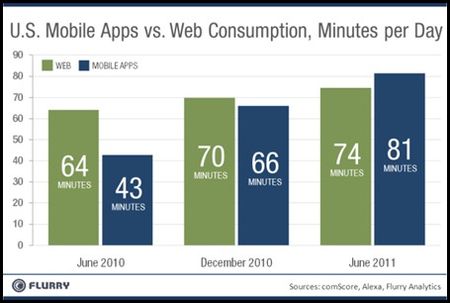
#v11 #HTML5 will certainly have an impact on web applications, but not nearly as much as hoped on the #mobile application market There’s a war on the horizon. But despite appearances, it’s a war for interactive web application dominance, and not one that’s likely to impact very heavily the war between mobile and web applications. First we have a report by ABI Research indicating a surge in the support of HTML5 on mobile devices indicating substantially impressive growth over the next five years. More than 2.1 billion mobile devices will have HTML5 browsers by 2016, up from just 109 million in 2010, according to a new report by ABI Research. -- The HTML Boom is Coming. Fast. (June 22, 2011) Impressive, no? But browser support does not mean use, and a report issued the day before by yet another analytics firm indicates that HTML5 usage on mobile applications is actually decreasing. Mobile applications are commanding more attention on smartphones than the web, highlighting the need for strong app stores on handset platforms. For the first time since Flurry, a mobile analytics firm, has been reporting engagement time of apps and web on smartphones, software is used on average for 81 minutes per day vs 74 minutes of web use. -- Sorry HTML 5, mobile apps are used more than the web (June 21, 2011) What folks seem to be missing – probably because they lack a background in development – is that the war is not really between HTML5 and mobile applications. The two models are very different – from the way in which they are developed and deployed to the way they are monetized. On the one hand you have HTML5 which, like its HTMLx predecessors, can easily be developed in just about any text editor and deployed on any web server known to man. On the other hand you have operating system and often device-specific development platforms that can only be written in certain languages and deployed on specific, targeted platforms. There’s also a marked difference in the user interface paradigm, with mobile device development heavily leaning toward touch and gesture-based interfaces and all that entails. It might appear shallow on the surface, but from a design perspective there’s a different mindset in the interaction when relying on gestures as opposed to mouse clicks. Consider those gestures that require more than one finger – enlarging or shrinking an image, for example. That’s simply not possible with one mouse – and becomes difficult to replicate in a non gesture-based interface. Similarly there are often very few “key" commands on mobile device applications and games. Accessibility? Not right now, apparently. That’s to say nothing of the differences in the development frameworks; the ones that require specific environments and languages. The advantages of HTML5 is that it’s cross-platform, cross-environment, and highly portable. The disadvantage is that you have little or no access to and control over system-level, well, anything. If you want to write an SSL VPN client, for example, you’re going to have to muck around in the network stack. That’s possible in a mobile device development environment and understandably impossible in a web-only world. Applications that are impossible to realistically replicate in a web application world– think graphic-intense games and simulation systems – are possible in a mobile environment. MOBILE BROADENING ITS USE The one area in which HTML5 may finally gain some legs and make a race out of applications with mobile apps is in its ability to finally leverage offline storage. The assumption for web applications has been, in the past, always on. Mobile devices have connectivity issues, attenuation and loss of signal interrupts connection-oriented applications and games. And let’s not forget the increasing pressure of data transfer caps on wireless networks (T-Mobile data transfer cap angers smartphone users, Jan 2011; O2 signals the end of unlimited data tariffs for iPhone customers, June 2010) that are also hitting broadband customers, much to their chagrin. But that’s exactly where mobile applications have an advantage over HTML5 and web applications, and why HTML5 with its offline storage capabilities comes in handy. But that would require rework on the part of application developers to adapt existing applications to fit the new model. Cookies and frequent database updates via AJAX/JSON is not a reliable solution on a sometimes-on device. And if you’re going to rework an application, why not target the platform specifically? Deployment and installation has reached the point of being as simple as opening a web page – maybe more so given the diversity of browsers and add-on security that can effectively prevent a web application requiring scripting or local storage access from executing at all. Better tracking of application reach is also possible with mobile platforms – including, as we’ve seen from the Flurry data, how much time is spent in the application itself. If you were thinking that mobile is a small segment of the population, think again. Tablets – definitely falling into the mobile device category based on their development model and portability - may be the straw that breaks the laptop’s back. Our exclusive first look at its latest report on how consumers buy and use tablets reveals an increasing acceptance--even reliance--on tablets for work purposes. Of the 1,000 tablet users surveyed, 57 percent said they are using tablets to replace laptop functions. Compared with a year ago, tablet owners are much less likely to buy a new laptop or Netbook, as well. Tablets are also cutting into e-reader purchase plans to an ever greater degree. What's more surprising, given the newness of the tablet market, is that 46 percent of consumers who already have a tablet are planning to buy another one. -- Report: Multi-tablet households growing fast (June 2011) This is an important statistic, as it may – combined with other statistics respecting the downloads of applications from various application stores and markets – indicate a growing irrelevance for web-based applications and, subsequently, HTML5. Mobile applications, not HTML5, are the new hotness. The losers to HTML5 will likely be Flash and video-based technologies, both of which can be replaced using HTML5 mechanisms that come without the headaches of plug-ins that may conflict, require upgrades and often are subject to targeted attacks by miscreants. I argued earlier this year that the increasing focus on mobile platforms and coming-of-age of HTML5 would lead to a client-database model of application development. Recent studies and data indicate that’s likely exactly where we’re headed – toward a client-database model that leverages the same database-as-a-service via a RESTful API and merely mixes up the presentation and application logic tiers on the client – whether through mobile device development kits or HTML5. As mobile devices – tablets, smartphones and whatever might come next – continue to take more and more mindshare from both the consumer and enterprise markets we’ll see more and more mobile-specific support for applications. You’ll note popular enterprise applications aren’t simply being updated to leverage HTML5 even though there is plenty of uptake in the market of the nascent specification. Users want native mobile platform applications – and they’re getting them. That doesn’t mean HTML5 won’t be a game-changer for web-applications – it likely will - but it does likely mean it won’t be a game-changer for mobile applications. Cloud-Tiered Architectural Models are Bad Except When They Aren’t Report: Multi-tablet households growing fast The HTML Boom is Coming. Fast. Sorry HTML 5, mobile apps are used more than the web The Database Tier is Not Elastic 80-line JavaScript Web Application Does This Application Make My Browser Look Fat? HTTP Now Serving … Everything The New Distribution of The 3-Tiered Architecture Changes Everything The Great Client-Server Architecture Myth400Views0likes0CommentsJSON versus XML: Your Choice Matters More Than You Think
Should the enterprise standardize on JSON or XML as their lingua franca for Web 2.0 integration? Or should they use both as best fits the application?The decision impacts more than just integration – it resounds across the entire infrastructure and impacts everything from security to performance to availability of those applications. One of the things a developer may or may not have control over when building enterprise applications is the format of the data used to communicate (integrate) with other applications. Increasingly services external to the enterprise are very Web 2.0 in that they provide HTTP-based APIs for integration that exchange data in one of a couple of standard formats: XML and JSON. While RSS and ATOM are also seen in APIs as options, these are generally used only when the data being presented is frequently updated and of a “listing” style nature. XML and JSON are used to deliver more complex structures that do not fit well in to the paradigm described by RSS and ATOM formatted information. Increasingly libraries or toolkits are used to build interactive Web 2.0 style applications – XAJAX, SAJAX, Dojo, Prototype, script.aculo.us – and these, too, generally default to XML or JSON, though other formats are often supported as well. So as you’re building out that Web 2.0 style application and thinking about the API you’re going to offer to make it easier for partners/customers/other departments to handle integration with their Web 2.0 style applications – or even thinking about the way in which data will be exchanged with the client (browser) - you need to think carefully about the choice you’re making. There are pros and cons to both JSON and XML, and the choice has implications outside the confines of application development in your organization. The debate on which is “best” or “optimal” is far from over, and it’s likely to eclipse – for developers anyway – the religious-style wars over the choice of browser. Even mainstream technology coverage is taking an interest in the subject. A recent piece from C|NET on “NoSQL and the future of cloud databases” says “Mapping object data to JSON, a JavaScript data interchange format, is far less complex. The "schemaless" nature of many of these products is an excellent fit with agile development methodologies.” Indeed, schemaless data formats are certainly more flexible, but that flexibility has a price that may need to be paid by the rest of the infrastructure.351Views0likes2Comments