certificate lifecycle management
1 Topic
Building a Certificate Lifecycle Manager with F5 BIG-IP Support — Looking for iControl REST Feedback
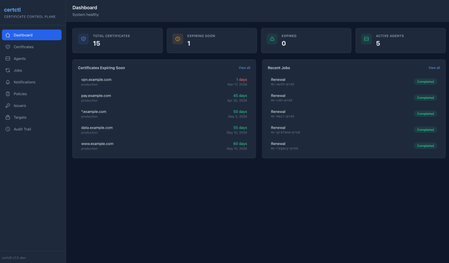
GitHub: https://github.com/shankar0123/certctl Managing certificate renewals on BIG-IP is one of those tasks that's easy to forget until it breaks something. The typical workflow is generate a CSR, submit to a CA, wait for issuance, download the cert, upload through the GUI or push via iControl REST, bind it to the right virtual server. This has too many manual steps and no central visibility into what's expiring when. I'm building certctl, a self-hosted certificate lifecycle platform, and F5 BIG-IP is one of the target connectors I'm working on. The platform already handles certificate issuance (built-in Local CA and ACME/Let's Encrypt with HTTP-01 challenges), configurable renewal policies, agent-based key generation (ECDSA P-256, private keys never leave the agent), threshold-based expiry alerting, policy enforcement, and an immutable audit trail. The NGINX target connector is fully implemented. Agents deploy certs via file write, nginx -t validation, and reload. Where I need feedback — the F5 connector: The F5 target connector interface is built and the iControl REST flow is mapped out, but I'm looking for input from people who manage certs on BIG-IP day to day before shipping the implementation. The planned flow is: Authenticate via POST /mgmt/shared/authn/login Upload cert PEM via POST /mgmt/tm/ltm/certificate Update the SSL profile via PATCH /mgmt/tm/ltm/profile/client-ssl/{profile} Validate deployment by checking profile status Questions for the community: Is this the right iControl REST flow for cert deployment, or are there edge cases I'm missing (e.g., cert bundles, intermediate chain handling, partition scoping)? Do most environments use client-ssl profiles directly, or is there a layer of indirection I should account for? Any gotchas with token-based auth vs. basic auth on newer BIG-IP versions?459Views0likes0Comments