ai
4 TopicsHey DeepSeek, can you write iRules?
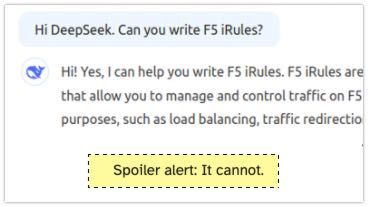
Back in time... Two years ago I asked ChatGPT whether it could write iRules. My conclusion after giving several tasks to ChatGPT was, that it can help with simple tasks but it cannot write intermediate or complex iRules. A new AI enters the competition Two weeks ago DeepSeek entered the scene and thought it's a good idea to ask it about its capabilities to write iRules. Spoiler alert: It cannot. New AI, same challenges I asked DeepSeek the same questions I asked ChatGPT 2 years ago. Write me an iRule that redirects HTTP to HTTPS Can you write an iRule that rewrites the host header in HTTP Request and Response? Can you write an iRule that will make a loadbalancing decision based on the HTTP Host header? Can you write an iRule that will make a loadbalancing decision based on the HTTP URI header? Write me an iRule that shows different ASM blocking pages based on the host header. The response should include the support ID. I stopped DeepSeek asking after the 5th question, DeepSeek is clueless about iRules. The answer I got from DeepSeek to 1, 2, 4 and 5 was always the same: when HTTP_REQUEST { # Check if the request is coming to port 80 (HTTP) if { [TCP::local_port] equals 80 } { # Construct the HTTPS URL set host [HTTP::host] set uri [HTTP::uri] set redirect_url "https://${host}${uri}" # Perform the redirect HTTP::redirect $redirect_url } } While this is a solution to task 1, it is plain wrong for 2, 3, 4 and 5. And even for the first challenge this is not a good. Actually it hurts me reading this iRule... Here for example task 2, just wrong... For task 3 DeepSeeks answer was: ChatGPT in 2025 For completeness, I gave the same tasks from 2023 to ChatGPT again. Briefly said - ChatGPT was OK in solving tasks 1-4 in 2023 and still is. It improved it's solution for task 5, the ASM iRule challenge. In 2023 I had two more tasks related to rewriting and redirecting. ChatGPT still failed to provide a solid solution for those two tasks. Conclusion DeepSeek cannot write iRules and ChatGPT still isn't good at it. Write your own iRules or ask the friendly people here on devcentral to help you.1.2KViews7likes14Comments
Context Cloak: Hiding PII from LLMs with F5 BIG-IP
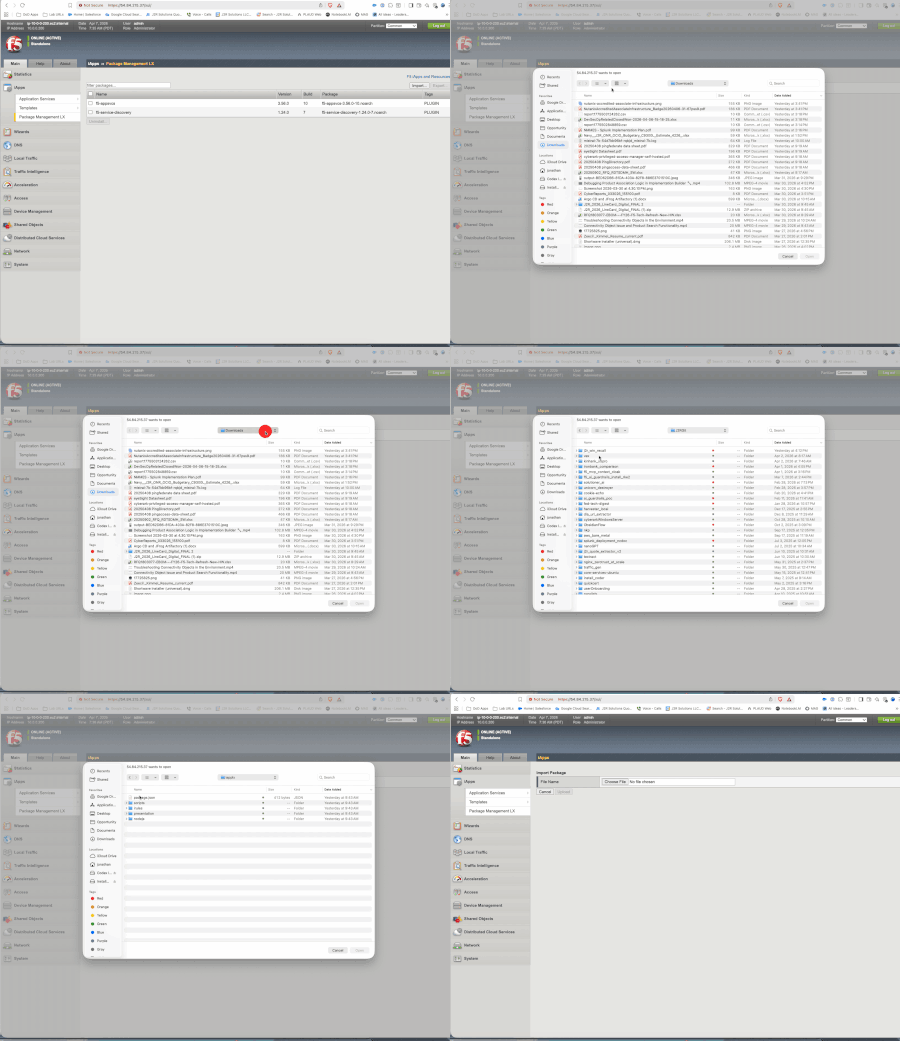
The Story As I dove deeper into the world of AI -- MCP servers, LLM orchestration, tool-calling models, agentic workflows -- one question kept nagging me: how do you use the power of LLMs to process sensitive data without actually exposing that data to the model? Banks, healthcare providers, government agencies -- they all want to leverage AI for report generation, customer analysis, and workflow automation. But the data they need to process is full of PII: Social Security Numbers, account numbers, names, phone numbers. Sending that to an LLM (whether cloud-hosted or self-hosted) creates a security and compliance risk that most organizations can't accept. I've spent years working with F5 technology, and when I learned that BIG-IP TMOS v21 added native support for the MCP protocol, the lightbulb went on. BIG-IP already sits in the data path between clients and servers. It already inspects, transforms, and enforces policy on HTTP traffic. What if it could transparently cloak PII before it reaches the LLM, and de-cloak it on the way back? That's Context Cloak. The Problem An analyst asks an LLM: "Generate a financial report for John Doe, SSN 078-05-1120, account 4532-1189-0042." The LLM now has real PII. Whether it's logged, cached, fine-tuned on, or exfiltrated -- that data is exposed. Traditional approaches fall short: Approach What Happens The Issue Masking (****) LLM can't see the data Can't reason about what it can't see Tokenization (<<SSN:001>>) LLM sees placeholders Works with larger models (14B+); smaller models may hallucinate Do nothing LLM sees real PII Security and compliance violation The Solution: Value Substitution Context Cloak takes a different approach -- substitute real PII with realistic fake values: John Doe --> Maria Garcia 078-05-1120 --> 523-50-6675 4532-1189-0042 --> 7865-4412-3375 The LLM sees what looks like real data and reasons about it naturally. It generates a perfect financial report for "Maria Garcia." On the way back, BIG-IP swaps the fakes back to the real values. The user sees a report about John Doe. The LLM never knew John Doe existed. This is conceptually a substitution cipher -- every real value maps to a consistent fake within the session, and the mapping is reversed transparently. When I was thinking about this concept, my mind kept coming back to James Veitch's TED talk about messing with email scammers. Veitch tells the scammer they need to use a code for security: Lawyer --> Gummy Bear Bank --> Cream Egg Documents --> Jelly Beans Western Union --> A Giant Gummy Lizard The scammer actually uses the code. He writes back: "I am trying to raise the balance for the Gummy Bear so he can submit all the needed Fizzy Cola Bottle Jelly Beans to the Creme Egg... Send 1,500 pounds via a Giant Gummy Lizard." The real transaction details -- the amounts, the urgency, the process -- all stayed intact. Only the sensitive terms were swapped. The scammer didn't even question it. That idea stuck with me -- what if we could do the same thing to protect PII from LLMs? But rotate the candy -- so it's not a static code book, but a fresh set of substitutions every session. Watch the talk: https://www.ted.com/talks/james_veitch_this_is_what_happens_when_you_reply_to_spam_email?t=280 Why BIG-IP? F5 BIG-IP was the natural candidate: Already in the data path -- BIG-IP is a reverse proxy that organizations already deploy MCP protocol support -- TMOS v21 added native MCP awareness via iRules iRules -- Tcl-based traffic manipulation for real-time HTTP payload inspection and rewriting Subtables -- in-memory key-value storage perfect for session-scoped cloaking maps iAppLX -- deployable application packages with REST APIs and web UIs Trust boundary -- BIG-IP is already the enforcement point for SSL, WAF, and access control How Context Cloak Works An analyst asks a question in Open WebUI Open WebUI calls MCP tools through the BIG-IP MCP Virtual Server The MCP server queries Postgres and returns real customer data (name, SSN, accounts, transactions) BIG-IP's MCP iRule scans the structured JSON response, extracts PII from known field names, generates deterministic fakes, and stores bidirectional mappings in a session-keyed subtable. The response passes through unmodified so tool chaining works. Open WebUI receives real data and composes a prompt When the prompt goes to the LLM through the BIG-IP Inference VS, the iRule uses [string map] to swap every real PII value with its fake counterpart The LLM generates its response using fake data BIG-IP intercepts the response and swaps fakes back to reals. The analyst sees a report about John Doe with his real SSN and account numbers. Two Cloaking Modes Context Cloak supports two modes, configurable per PII field: Substitute Mode Replaces PII with realistic fake values. Names come from a deterministic pool, numbers are digit-shifted, emails are derived. The LLM reasons about the data naturally because it looks real. John Doe --> Maria Garcia (name pool) 078-05-1120 --> 523-50-6675 (digit shift +5) 4532-1189-0042 --> 7865-4412-3375 (digit shift +3) [email protected] --> [email protected] (derived) Best for: fields the LLM needs to reason about naturally -- names in reports, account numbers in summaries. Tokenize Mode Replaces PII with structured placeholders: 078-05-1120 --> <<SSN:32.192.169.232:001>> John Doe --> <<name:32.192.169.232:001>> 4532-1189-0042 --> <<digit_shift:32.192.169.232:001>> A guidance prompt is automatically injected into the LLM request, instructing it to reproduce the tokens exactly as-is. Larger models (14B+ parameters) handle this reliably; smaller models (7B) may struggle. Best for: defense-in-depth with F5 AI Guardrails. The tokens are intentionally distinctive -- if one leaks through de-cloaking, a guardrails policy can catch it. Both modes can be mixed per-field in the same request. The iAppLX Package Context Cloak is packaged as an iAppLX extension -- a deployable application on BIG-IP with a REST API and web-based configuration UI. When deployed, it creates all required BIG-IP objects: data groups, iRules, HTTP profiles, SSL profiles, pools, monitors, and virtual servers. The PII Field Configuration is the core of Context Cloak. The admin selects which JSON fields in MCP responses contain PII and chooses the cloaking mode per field: Field Aliases Mode Type / Label full_name customer_name Substitute Name Pool ssn Tokenize SSN account_number Substitute Digit Shift phone Substitute Phone email Substitute Email The iRules are data-group-driven -- no PII field names are hardcoded. Change the data group via the GUI, and the cloaking behavior changes instantly. This means Context Cloak works with any MCP server, not just the financial demo. Live Demo Enough theory -- here's what it looks like in practice. Step 1: Install the RPM Installing Context Cloak via BIG-IP Package Management LX Step 2: Configure and Deploy Context Cloak GUI -- MCP server, LLM endpoint, PII fields, one-click deploy Deployment output showing session config and saved configuration Step 3: Verify Virtual Servers BIG-IP Local Traffic showing MCP VS and Inference VS created by Context Cloak Step 4: Baseline -- No Cloaking Without Context Cloak: real PII flows directly to the LLM in cleartext This is the "before" picture. The LLM sees everything: real names, real SSNs, real account numbers. Demo 1: Substitute Mode -- SSN Lookup Prompt: "Show me the SSN number for John Doe. Just display the number." Substitute mode -- Open WebUI + Context Cloak GUI showing all fields as Substitute Result: User sees real SSN 078-05-1120. LLM saw a digit-shifted fake. Demo 2: Substitute Mode -- Account Lookup Prompt: "What accounts are associated to John Doe?" Left: Open WebUI with real data. Right: vLLM logs showing "Maria Garcia" with fake account numbers What the LLM saw: "customer_name": "Maria Garcia" "account_number": "7865-4412-3375" (checking) "account_number": "7865-4412-3322" (investment) "account_number": "7865-4412-3376" (savings) What the user saw: Customer: John Doe Checking: 4532-1189-0042 -- $45,230.18 Investment: 4532-1189-0099 -- $312,500.00 Savings: 4532-1189-0043 -- $128,750.00 Switching to Tokenize Mode Changing PII fields from Substitute to Tokenize in the GUI Demo 3: Mixed Mode -- Tokenized SSN SSN set to Tokenize, name set to Substitute. Prompt: "Show me the SSN number for Jane Smith. Just display the number." Mixed mode -- real SSN de-cloaked on left, <<SSN:...>> token visible in vLLM logs on right What the LLM saw: "customer_name": "Maria Thompson" "ssn": "<<SSN:32.192.169.232:001>>" What the user saw: Jane Smith, SSN 219-09-9999 Both modes operating on the same customer record, in the same request. Demo 4: Full Tokenize -- The Punchline ALL fields set to Tokenize mode. Prompt: "Show me the SSN and account information for Carlos Rivera. Display all the numbers." Full tokenize -- every PII field as a token, all de-cloaked on return What the LLM saw -- every PII field was a token: "full_name": "<<name:32.192.169.232:001>>" "ssn": "<<SSN:32.192.169.232:002>>" "phone": "<<phone:32.192.169.232:002>>" "email": "<<email:32.192.169.232:001>>" "account_number": "<<digit_shift:32.192.169.232:002>>" (checking) "account_number": "<<digit_shift:32.192.169.232:003>>" (investment) "account_number": "<<digit_shift:32.192.169.232:004>>" (savings) What the user saw -- all real data restored: Name: Carlos Rivera SSN: 323-45-6789 Checking: 6789-3345-0022 -- $89,120.45 Investment: 6789-3345-0024 -- $890,000.00 Savings: 6789-3345-0023 -- $245,000.00 And here's the best part. Qwen's last line in the response: "Please note that the actual numerical values for the SSN and account numbers are masked due to privacy concerns." The LLM genuinely believed it showed the user masked data. It apologized for the "privacy masking" -- not knowing that BIG-IP had already de-cloaked every token back to the real values. The user saw the full, real, unmasked report. What's Next: F5 AI Guardrails Integration Context Cloak's tokenize mode is designed to complement F5 AI Guardrails. The <<TYPE:ID:SEQ>> format is intentionally distinctive -- if any token leaks through de-cloaking, a guardrails policy can catch it as a pattern match violation. The vision: Context Cloak as the first layer of defense (PII never reaches the LLM), AI Guardrails as the safety net (catches anything that slips through). Defense in depth for AI data protection. Other areas I'm exploring: Hostname-based LLM routing -- BIG-IP as a model gateway with per-route cloaking policies JSON profile integration -- native BIG-IP JSON DOM parsing instead of regex Auto-discovery of MCP tool schemas for PII field detection Centralized cloaking policy management across multiple BIG-IP instances Try It Yourself The complete project is open source: https://github.com/j2rsolutions/f5_mcp_context_cloak The repository includes Terraform for AWS infrastructure, Kubernetes manifests, the iAppLX package (RPM available in Releases), iRules, sample financial data, a test script, comprehensive documentation, and a full demo walkthrough with GIFs (see docs/demo-evidence.md). A Note on Production Readiness I want to be clear: this is a lab proof-of-concept. I have not tested this in a production environment. The cloaking subtable stores PII in BIG-IP memory, the fake name pool is small (100 combinations), the SSL certificates are self-signed, and there's no authentication on the MCP server. There are edge cases around streaming responses, subtable TTL expiry, and LLM-derived values that need more work. But the core concept is proven: BIG-IP can transparently cloak PII in LLM workflows using value substitution and tokenization, and the iAppLX packaging makes it deployable and configurable without touching iRule code. I'd love to hear what the community thinks. Is this approach viable for your use cases? What PII types would you need to support? How would you handle the edge cases? What would it take to make this production-ready for your environment? Let me know in the comments -- and if you want to contribute, PRs are welcome! Demo Environment F5 BIG-IP VE v21.0.0.1 on AWS (m5.xlarge) Qwen 2.5 14B Instruct AWQ on vLLM 0.8.5 (NVIDIA L4, 24GB VRAM) MCP Server: FastMCP 1.26 + PostgreSQL 16 on Kubernetes (RKE2) Open WebUI v0.8.10 Context Cloak iAppLX v0.2.0 References Managing MCP in iRules -- Part 1 Managing MCP in iRules -- Part 2 Managing MCP in iRules -- Part 3 Model Context Protocol Specification James Veitch: This is what happens when you reply to spam email (TED, skip to 4:40)303Views2likes0CommentsDNS: El protocolo que nadie ve...hasta que se convierte en el problema más grande de la arquitectura
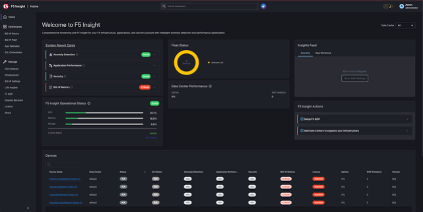
En el día a día de operación, el DNS rara vez está en el centro de la conversación. No suele ser el protagonista de los roadmaps, ni el primer punto que se revisa en un diseño nuevo. Muchas veces se asume que "ya está ahí", funcionando, resolviendo nombres sin mayor fricción. Y eso es precisamente lo peligroso. Después de años trabajando con arquitecturas empresariales y de Service Providers, hay una constante difícil de ignorar: el DNS es uno de los componentes más críticos de la infraestructura moderna y, al mismo tiempo, uno de los más subestimados. Cuando todo funciona, nadie pregunta por él. Cuando algo falla, todo lo demás deja de importar. He visto aplicaciones "arriba", enlaces estables, firewalls en verde... pero usuarios incapaces de acceder a un servicio. El problema no estaba en la aplicación ni en la red, sino en ese primer paso que todos damos por sentado: resolver un nombre. DNS en la vida real: cuando la teoría se encuentra con la operación En el papel, el DNS parece simple, pero en producción, no lo es. En arquitecturas reales, el DNS participa activamente en decisiones críticas como: A qué sitio o región se dirige un usuario Qué backend recibe una solicitud Cómo se distribuye la carga entre múltiples data centers Qué tan rápido se recupera un servicio ante una degradación o caída En Service Providers y grandes organizaciones, esto se vuelve evidente durante eventos inesperados. Un sismo, una noticia de alto impacto, un evento deportivo global, una actualización urgente de una aplicación, una app que se vuelve tendencia, un anuncio gubernamental o una contingencia sanitaria pueden disparar el tráfico digital en cuestión de minutos. En estos escenarios, el primer crecimiento significativo no ocurre en HTTP ni en TLS, sino en las consultas DNS. Millones de usuarios abren aplicaciones, refrescan portales y generan resoluciones simultáneas hacia los mismos dominios. Si el DNS no está preparado para absorber ese pico: La aplicación nunca recibe tráfico Los balanceadores no alcanzan a participar La experiencia del usuario se degrada de inmediato Aquí es donde soluciones como F5 BIG-IP DNS dejan de ser un "servicio de nombres" y se convierten en un componente activo de control de tráfico, capaz de tomar decisiones basadas en: Estado real de los servicios Salud de los backends Políticas de disponibilidad y continuidad El boom de la inteligencia artificial y su impacto directo en DNS La llegada masiva de la Inteligencia Artificial no solo ha cambiado cómo se consumen aplicaciones; ha cambiado radicalmente el patrón del tráfico. Las arquitecturas modernas de IA introducen: Más microservicios desacoplados Más APIs internas y externas Endpoints efímeros que aparecen y desaparecen Resoluciones dinámicas y frecuentes Cada llamada a un modelo, cada inferencia distribuida y cada backend que escala automáticamente comienza con una consulta DNS. Pero el impacto va mucho más allá de la teoría. Los datos de 2025 lo confirman de forma contundente: Según Humansecurity, el tráfico generado por sistemas de inteligencia artificial casi se triplicó en un solo año, con un crecimiento mensual del 187% entre enero y diciembre. Y dentro de ese universo, el segmento que más creció fue el de agentes autónomos de IA — bots que ya no solo leen la web, sino que interactúan con ella: navegan, consultan APIs, completan transacciones. Ese tipo de tráfico creció más de un 7,800% interanual. ¿Qué significa esto para el DNS? Cada vez que un agente de IA resuelve una consulta, busca un endpoint o escala un servicio, hay una resolución DNS detrás. Y no estamos hablando de patrones predecibles. El tráfico de IA se comporta de forma diferente al tráfico humano: es más agresivo en ráfagas, menos predecible en horarios, y crece a un ritmo ocho veces mayor que el tráfico generado por personas. A esto se suma que los crawlers de IA — los sistemas que rastrean contenido para entrenamiento, búsqueda y acciones en tiempo real — se han convertido en una de las fuentes más grandes de tráfico automatizado en internet. Durante 2025, solo el crawler de Google generó aproximadamente el 4.5% de todas las solicitudes HTML hacia sitios protegidos por las principales plataformas de seguridad. Y el crawling por "acción de usuario" (cuando un usuario le pide algo a un chatbot y este sale a buscar información en la web) creció más de 15 veces en el mismo periodo. Desde una perspectiva técnica, esto tiene implicaciones claras: Crecimiento sostenido y acelerado del volumen de consultas DNS Mayor sensibilidad a latencia y jitter en la resolución Mayor impacto de fallas parciales o intermitentes Patrones de tráfico menos predecibles y más difíciles de planificar El DNS deja de ser infraestructura "estática" y se convierte en un componente dinámico del plano de datos, íntimamente ligado al desempeño de los modelos y servicios de IA. Y quien no esté dimensionando su infraestructura DNS con esta variable en mente, va a sentir el impacto más temprano que tarde. El DNS como punto crítico en eventos globales A lo largo de los años, múltiples eventos han demostrado el impacto del DNS a escala global. Desde interrupciones masivas de servicios digitales hasta ataques de amplificación, el patrón es consistente: cuando el DNS se ve afectado, el impacto se multiplica. Y no hay que ir lejos para encontrar ejemplos. Solo en octubre de 2025, dos incidentes dejaron muy claro lo que pasa cuando el DNS falla en entornos de producción reales. En el primero, un error en el sistema automatizado de gestión DNS de una de las principales plataformas de nube pública dejó inaccesibles servicios críticos en la región más grande de su infraestructura. Los servidores estaban operativos, las bases de datos intactas... pero el DNS los hacía invisibles. La falla se propagó en cascada a más de cien servicios, afectó a miles de empresas en más de 60 países y generó millones de reportes de caída en cuestión de horas. Plataformas de mensajería, gaming, streaming, servicios financieros y hasta aplicaciones gubernamentales quedaron fuera de línea. No fue un ataque. Fue un error de automatización en DNS. Días después, un proveedor de telecomunicaciones europeo con millones de clientes de red fija experimentó una falla de resolución DNS que dejó sin acceso a internet a gran parte de su base de usuarios durante varias horas. El tráfico observado cayó más del 75%. Y la causa raíz fue, nuevamente, un problema de resolución DNS — no un corte de fibra, no un ataque DDoS, no una caída de energía. F5 Labs ha documentado ampliamente cómo: Ataques volumétricos utilizan DNS como vector principal La amplificación DNS sigue siendo una técnica efectiva Eventos globales generan patrones de tráfico anómalos que exponen debilidades de diseño Estos escenarios no distinguen industria ni tamaño. Afectan por igual a proveedores de servicios, plataformas digitales, infraestructura crítica y aplicaciones empresariales. La diferencia no está en si ocurren, sino en qué tan preparada está la arquitectura para absorberlos sin colapsar. Primero la observabilidad: entender antes de reaccionar Durante mucho tiempo, el DNS fue una caja negra. Funcionaba... o no. Hoy, la conversación cambia por completo cuando incorporamos observabilidad real a la ecuación. F5 Insight, componente clave dentro de la plataforma F5 ADSP, permite: Analizar patrones reales de consultas Identificar picos atípicos y comportamientos anómalos Correlacionar eventos externos con tráfico DNS Entender el porqué detrás del comportamiento del sistema Pero F5 Insight va más allá de dashboards y métricas. Incorpora inteligencia artificial para ofrecer guía proactiva, detección de anomalías y algo que cambia la forma de operar: la capacidad de interactuar con tus datos operacionales en lenguaje natural, usando integración con LLMs y el Model Context Protocol (MCP). En la práctica, esto significa pasar de revisar dashboards buscando qué pasó, a recibir narrativas operacionales que te dicen qué está pasando, por qué, y qué deberías priorizar. Para entornos con alta densidad de consultas DNS, donde los patrones cambian en minutos y los picos pueden ser impredecibles,especialmente con el crecimiento del tráfico de IA, ese salto de reactivo a proactivo no es un lujo, es una necesidad operativa. En escenarios de alto QPS, el problema no siempre es la capacidad, sino cómo se comporta el tráfico. Ver el DNS como datos, no solo como servicio, marca una diferencia enorme en operación y planeación.Plataforma y arquitectura: cuando el DNS ya no es "básico" Plataforma y arquitectura: cuando el DNS ya no es "básico" Cuando el DNS se vuelve crítico, la plataforma importa. Arquitecturas basadas en VELOS permiten separar capacidad, resiliencia y crecimiento del ciclo de vida de la aplicación, soportando cargas DNS masivas con aislamiento, alta disponibilidad y escalamiento ordenado. Por su parte, rSeries ofrece un modelo más compacto y eficiente, ideal para despliegues donde el rendimiento por unidad, la latencia y la eficiencia operativa son clave. Y cuando la aplicación ya no vive en un solo data center, F5 Distributed Cloud Services extiende las capacidades del DNS a arquitecturas híbridas y multicloud, manteniendo: Políticas consistentes Visibilidad unificada Control desde el edge hasta el backend El punto no es dónde corre el DNS, sino que acompañe a la aplicación sin perder control, resiliencia ni observabilidad. Seguridad integrada desde el primer paquete El DNS también es una superficie de ataque. Lo hemos comprobado una y otra vez durante eventos de seguridad globales. Y el panorama no se está simplificando: durante 2025, se identificaron más de 100 millones de dominios nuevos, de los cuales una cuarta parte fue clasificada como maliciosos o sospechosos. Los atacantes están registrando volúmenes sin precedentes de dominios, usando automatización para montar campañas masivas que evaden defensas tradicionales. Ignorar al DNS desde el punto de vista de seguridad es dejar una puerta abierta. Integrar protección dentro de la misma plataforma de entrega permite: Mitigar ataques sin introducir latencia adicional Aplicar políticas de forma consistente Mantener visibilidad unificada del tráfico Seguridad, rendimiento y disponibilidad no son capas separadas; son partes del mismo flujo. En ocasiones olvidamos Que el DNS no suele fallar de forma dramática. Falla de forma silenciosa... y por eso es tan peligroso. Invertir en su diseño, observabilidad y seguridad no es sobreingeniería. Es entender que todo empieza ahí. En un mundo donde la IA está triplicando el volumen de tráfico automatizado año con año, donde los agentes autónomos generan resoluciones DNS a un ritmo que no existía hace 18 meses, y donde un solo error de automatización en DNS puede dejar fuera a miles de empresas en más de 60 países... el DNS vuelve a ocupar el lugar que siempre tuvo en la arquitectura, aunque muchos lo hayan olvidado. La pregunta no es si el DNS es crítico. La pregunta es si tu arquitectura está lista para tratarlo como tal.212Views1like0Comments