cloud
3987 TopicsNGINX Gateway Fabric - Data Plane Programmability with NGINX JavaScript
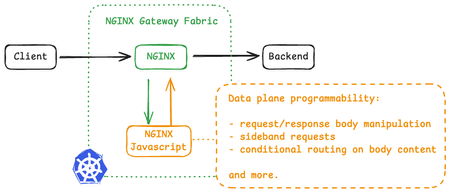
This post walks through a pattern for injecting NGINX JavaScript logic into NGINX Gateway Fabric using Kubernetes-native extension points to enable data plane programmability, with an F5 AI Guardrails integration as a worked example.13Views0likes0CommentsSingle-click CDN Experience for F5 Distributed Cloud Load Balancers
Fundamentals The modern CDN has evolved well beyond cache and serve. Today’s platforms are intelligent edge fabrics that combine performance optimization, layered security, multicloud routing, and even workload execution at the edge. Few products embody this evolution more completely than F5 Distributed Cloud CDN, and this post explores both why CDNs matter and what sets F5’s newest approach apart. At its core, a CDN is a globally distributed system of edge servers, called PoPs or Regional Edges (RE), that cache content and handle user requests on behalf of the server origin. When a user requests a resource, DNS resolution routes them to the nearest PoP. If the resource is cached there (a “cache hit”), it’s returned immediately. If not (a “cache miss”), the PoP fetches it from the origin, stores it, and returns it to the user. The speed improvement isn’t just perceptual. Reduced Round-Trip Time (RTT) correlates directly with business outcomes. Every page load shaved makes a difference for search rankings, checkout completion, and ad viewability all improve with lower latency. CDNs don’t just make things faster; they make digital businesses more competitive. To put the difference in concrete terms, here’s how a typical 200KB page might deliver across different scenarios. Platform deep dive Traditional CDNs optimize for one thing: getting cached bytes to users fast. Distributed Cloud CDN starts there but doesn’t stop, it's engineered as a unified platform where content delivery, application security, multicloud connectivity, and edge compute converge under a single operational surface. F5’s approach is architecturally distinct Most CDNs are standalone services that organizations integrate with separate security tools, load balancers, and observability stacks. The operational overhead of stitching these together and keeping policies consistent across them is substantial. F5 takes a different approach: CDN is one capability within the broader Distributed Cloud Platform, meaning it inherits the platform’s DNS, load balancing, WAF, observability, and multicloud networking services. The practical result, noted by enterprise users, is that WAF rules, DDoS policies, and CDN configurations all live in the same console. There’s no context switching between vendors, no policy drift between your security tool and your delivery tool, and no blind spots at the handoff between them. In the newest product update, anyone already using a Distributed Cloud Load Balancer can enable CDN acceleration with a single click: no rearchitecting, no new deployments. Built-in cacheability insights estimate performance improvement and cost savings before activation, so teams can make informed decisions without guesswork. Target use cases: Where F5 Distributed Cloud CDN fits best There are three primary use-case families for enabling an integrated CDN: Secure apps everywhere (WAAP + CDN): Organizations that need comprehensive web app and API protection with WAF, DDoS, bot defense, unified content delivery under a single policy plane and management console. Modern digital experiences: Dynamic, personalized applications spanning multiple public clouds, edge locations, and on-premises infrastructure that need consistent delivery regardless of where origin workloads live. Multicloud & edge initiatives: Enterprises migrating workloads across cloud providers or deploying edge compute who need a platform that bridges delivery, security, and service mesh without re-platforming for each environment. Visibility & Control: You can’t optimize what you can’t see F5’s Distributed Cloud Platform ships with unified observability that spans delivery performance and security posture. Real-time dashboards expose traffic patterns, cache efficiency metrics, origin health, and security event timelines, all from the same interface used to configure policies. Cache efficiency isn’t a static attribute either. Distributed Cloud CDN provides granular control over cache keys, TTL values, and path or header-based caching rules, enabling teams to optimize hit rates for specific content types and access patterns. Cacheability insights indicate which web apps are candidates for acceleration. For security operations, the edge generates rich telemetry: request rates, blocked attack types, geographic traffic distribution, and bot classification outcomes. This feeds into the same observability layer as performance data, giving teams a single pane of glass rather than separate dashboards for CDN and security. The recently announced F5 Insight capability extends this further, bringing OpenTelemetry-powered observability across BIG-IP, NGINX, and Distributed Cloud Services, consolidating performance and security intelligence across an organization’s entire F5 footprint into actionable, unified visibility. Demo Walkthrough Final thoughts A CDN is no longer an optimization. It’s table stakes for any organization serving digital experiences to a geographically distributed audience. The question isn’t whether to deploy one, but which platform best aligns with the complexity of your architecture and the ambition of your security posture. For organizations operating at the intersection of multicloud delivery, API-driven applications, and enterprise security requirements, Distributed Cloud CDN represents a compelling architectural choice: a platform that treats performance and security not as separate concerns to be stitched together, but as integrated properties of the same edge fabric. The bytes will always need to get from somewhere to your users. F5 makes that journey faster, safer, and smarter. Additional Resources Product information: https://www.f5.com/products/distributed-cloud-services/cdn Technical documentation: https://docs.cloud.f5.com/docs-v2/content-delivery-network/how-to/cdn-mgmt/conf-cache-lb Feature announcement blog: https://www.f5.com/company/blog/f5-distributed-cloud-cdn-faster-apps-one-click-enablement-lower-costs 285Views1like0Comments
Forwarding Logs to SIEM Tools via HTTP Proxy for F5 Distributed Cloud Global Log Receiver
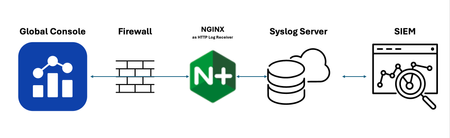
Purpose This guide provides a solution for forwarding logs to SIEM tools that support syslog but lack HTTP/HTTPS ingestion capabilities. It covers the deployment and tuning of an HTTP Proxy log receiver configured to work with F5 Distributed Cloud (XC) Global Log Receiver settings. Audience: This guide is intended for technical professionals, including SecOps teams and Solution Architects, who are responsible for integrating SIEM tools with F5 XC Global Log Receiver. Readers should have a solid understanding of HTTP communication (methods, request body, reverse proxy), syslog, and data center network architecture. Familiarity with F5 XC concepts such as namespaces, log types, events, and XC-GLR is also required. Introduction: Problem Statement: SIEM tools often support syslog ingestion but lack HTTP/HTTPS log reception capabilities. Objective: Explain how to deploy and configure an HTTP Proxy to forward logs to F5 Distributed Cloud Global Log Receiver. Solution Overview: Architecture Diagram and workflow: Configuration Steps: Configure Global Log Receiver in F5 Distributed Cloud Console Navigate to: Home → Shared Configuration → Global Log Receiver Create or edit the Global Log Receiver settings for HTTP receiver Ensure the Global Log Receiver batch size is based on the payload size expected from F5 NGINX. Example configuration snap: Set Up NGINX as an HTTPs Log Receiver Install NGINX on your designated server. Configure log_format Configure NGINX to accept HTTP POST requests only and forward access logs to syslog Example configuration snippet: log_format custom_log_format_1 escape=json $request_body; # Example: include request body only server { listen 443 ssl; server_name <logreceiver_server_name>; ssl_certificate /etc/ssl/<logreceiver_server_cert>; ssl_certificate_key /etc/ssl/<logreceiver_server_key>; # Other SSL/TLS configurations (e.g., protocols, ciphers) ssl_protocols TLSv1.2 TLSv1.3; ssl_ciphers HIGH:!aNULL:!MD5; client_body_in_single_buffer on; # The directive is recommended when using the $request_body variable, to save the number of copy operations involved client_body_in_file_only off; #default client_max_body_size 32M; # based on tuning gzip on; location /log_endpoint { # Allow only POST requests for sending log data limit_except POST { deny all; } # Configure access_log to write incoming data to a file # access_log /var/log/nginx/log_receiver.log custom_log_format_1; access_log syslog:server=127.0.0.1:514,facility=local7,tag=nginx,severity=info custom_log_format_1; proxy_pass http://localhost:8091/; # This dummy Internal server required to collect request_body variable. } } # dummy internal server to respond back 200 ok server { listen 8091; server_name localhost; location / { return 200 "Log received successfully."; } } Set Up rsyslog server Install/configure rsyslog on your designated server. Configure 60-nginx.conf file in /etc/rsyslog.d/ directory Sample 60-nginx.conf file #nginx.* @@127.0.0.1:514 :syslogtag, isequal, "[nginx]" /var/log/nginx-syslog/nginx-access-log.log OR Set Up BIG-IP as an HTTPs Log Receiver Syslog pool ltm pool glr_syslog_pool { members { <syslog-servr-ip>:514 { address <syslog-server-ip-address> session monitor-enabled state up } } monitor tcp } iRule for hsl logging when CLIENT_ACCEPTED priority 500 { set hsl_handle "" set request_body "" } when HTTP_REQUEST priority 500 { if { [HTTP::method] eq "POST" } { HTTP::collect [HTTP::header Content-Length] } else { HTTP::respond 200 content "data received" } } when HTTP_REQUEST_DATA priority 500 { set request_body [HTTP::payload] if { ! [info exists hsl_handle] || $hsl_handle eq "" } { set hsl_handle [HSL::open -proto UDP -pool "/Common/glr_syslog_pool"] } HSL::send $hsl_handle "<134> XC_LOG: $request_body" HTTP::respond 200 content "data received" HTTP::release } Virtual Server configuration ltm virtual vs-3 { destination <vs-ip>:443 ip-protocol tcp mask 255.255.255.255 profiles { demo-ent-merja-in { context clientside } http { } tcp { } } rules { <iRule-created-in-earlier-step> } serverssl-use-sni disabled source 0.0.0.0/0 source-address-translation { type automap } translate-address enabled translate-port enabled } rsyslog server config inputs #### The following modules are enabled in rsyslogd.conf module(load="omfile") module(load="imtcp") input(type="imtcp" port="514") ### /etc/rsyslog.d/70-bigip.conf template(name="F5_Format" type="string" string="%TIMESTAMP% %msg%\n") if ($msg contains "XC_LOG:") then { action( type="omfile" File="/var/log/10.1.20.177/f5_hsl_custom.log" Template="F5_Format" ) stop } References: F5 Distributed Cloud Global log receiver supports many log receivers natively: F5 Distributed Cloud Technical Knowledge page on "Configure Global Log receiver" Prerequisites: An external log collection system reachable publicly. The following IP address ranges are required to be added to your firewall's allowlist: 193.16.236.64/29 185.160.8.152/29639Views6likes0Comments
What configuration issue am I experiencing with this 130-domain VS ?
Hello, I am using an F5 WAF device running BIG-IP ISO version 16.1.4.2. I am currently facing an issue within a Virtual Server (VS) that runs a total of 130 domains. When the F5 WAF device undergoes CPU overload, only the services hosted on this specific 130-domain VS are failing, while all other Virtual Servers continue to operate normally. What configuration issue am I experiencing with this 130-domain VS, and what is the resolution for it? For the time being, I have disabled this VS to keep the F5 WAF device running stably. Thank you very much!93Views0likes1Comment
What's new in BIG-IP v21.1?
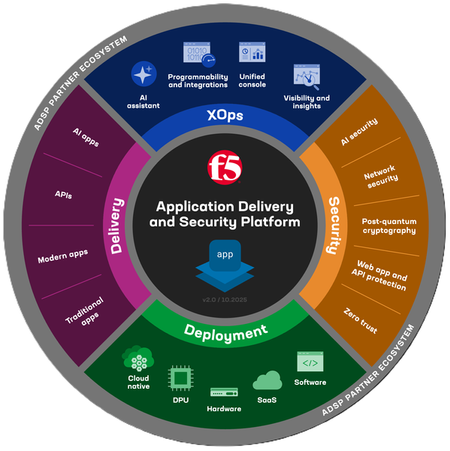
Introduction F5 has officially released BIG-IP v21.1, delivering cutting-edge innovations designed to meet the dynamic needs of businesses and organizations. This version introduces advanced features such as quantum-resistant cryptography, AI-driven enhancements, protocol protection, and significant strides in software modernization. Packed with fixes and powerful new capabilities, BIG-IP v21.1 strengthens the F5 Application Delivery and Security Platform (ADSP) by improving delivery, security, and deployment, ensuring your applications remain fast, secure, and simple to manage. PQC Readiness Support for Additional NIST-Compliant PQC Key Exchanges Building upon the groundwork laid in v17.5.0, BIG-IP v21.1 introduces expanded Post Quantum Cryptography (PQC) support. This release adds SecP + ML-KEM key exchanges, combining traditional cryptographic methods with quantum-resistant algorithms for hybrid cryptography. New Supported Key Exchanges: SecP256r1ML-KEM-768 SecP384r1ML-KEM-1024 These enhancements benefit organizations in government and regulated industries adhering to NIST guidelines and FIPS standards. Both client- and server-side connections are supported alongside SSL Forward Proxy use cases. Quantum-Resistant TLS/SSL VPN Tunneling As quantum computing emerges, traditional encryption methods face threats from advanced computational power. To counteract this, BIG-IP Zero Trust Access (formerly BIG-IP APM) introduces quantum-resistant TLS/SSL VPN tunneling with X25519 + ML-KEM-768 hybrid key exchanges. This solution ensures NIST compliance while securing modern VPN tunnels. AI Workload Delivery, Security, and Access Enhancements Expanded Security and Delivery for Model Context Protocol (MCP) BIG-IP v21.1 enhances MCP support to ensure secure and consistent communication between AI models, applications, and data sources. MCP Protection: BIG-IP Advanced WAF now inspects MCP traffic, shielding AI workflows from emerging threats such as tool poisoning, secret exposure, and injection attacks detailed in the OWASP MCP Top 10. A new Security Policy template called MCP Protection Policy has been added: A new Blocking Page Response type has been added. The MCP Session ID is included in the Response Headers: The MCP Request ID is included in the Response Body: Sample response for an “Echo tool”: Sample rejected response: MCP Session Persistence: New session persistence for MCP traffic ensures smoother workflows by consistently routing session requests to the correct server. A new MCP Persistence Profile aimcp has been added: Optimized Agent-to-Agent Connectivity The introduction of experimental support for the Agent2Agent (A2A) protocol optimizes communication between AI agents, ensuring interoperability across fragmented platforms. Features Include: Load balancing for A2A traffic. Governance via iRules based logging and visibility. While experimental in v21.1, future releases promise full support with expanded management capabilities. Seamless, Secure Access for AI Agents The Dynamic Client Registration (DCR) capability expedites access requests for agentic AI systems. Agents can register themselves programmatically with BIG-IP Zero Trust Access, eliminating manual steps and streamlining workflows via API driven automation. F5 BIG-IP Zero Trust Access enables dynamic client registration to expedite access requests. Modern API and Protocol Protection HTTP/3 Protocol Traffic Security With HTTP/3 adoption expected to surpass HTTP/2 soon, BIG-IP Advanced WAF brings cutting edge protection for HTTP/3 traffic, matching the security levels of earlier protocol versions. Currently limited to client side protection, server side capabilities will follow in subsequent releases. OpenAPI 3.1 Specification Support BIG-IP Advanced WAF now protects APIs defined by OpenAPI 3.1, learning expected endpoints, data types, and security requirements while blocking improper requests, undocumented endpoint abuse, and API specific attacks. Previous OpenAPI versions (2.0, 3.0) remain supported. BIG-IP TMOS Software Modernization DNS Enhancements Multiple Response Policy Zones Feed Zones DNS security and efficiency are strengthened with the ability to configure and consolidate multiple RPZ feeds into a single DNS cache profile. Enhanced DNS Threat Mitigation Improved granularity allows IP-based blocking for malicious domains and dynamic responses to regional compliance mandates. Flexible DNS Response Actions Organizations gain flexibility to block, redirect, or manage traffic dynamically, streamlining DNS-level policy management. BIG-IP TMOS Software Modernization Introducing the New BIG-IP Declarative API Designed for modern application environments, the new BIG-IP Declarative API (in Alpha state) offers: Integrated lifecycle management. Per-app scalability for simplified configurations. Broadened automation capabilities with near real-time deployment. This marks a significant upgrade over AS3, empowering faster and more efficient automation workflows. Continued Control Plane Enhancements Control plane improvements focus on reliability, performance, and resource efficiency through upgrades to MCPd, iControl REST, and the BigD daemon. These enhancements: Speed up iControl REST API requests by up to 10%. Boost control-plane resilience under low-memory conditions. Enable multi-threaded scalability for BigD health monitoring. Expect recurring advancements across future BIG-IP versions. New Features in SSL Orchestrator v14 Policy-based Dynamic Egress Routing Policy-based dynamic egress routing is introduced in SSL Orchestrator that enables you to easily define egress routes based on traffic conditions, directly within the policy definition, thereby avoiding the need to configure complex layers involving multiple topologies and iRules. This feature is supported for Outbound and Inbound Gateway topologies. You can create a policy in BIG-IP LTM tailored to your routing requirements and then attach the policy to the SSL Orchestrator Virtual Server. This will ensure that the traffic is dynamically routed to the appropriate egress route based on the configurations defined within the LTM policy. L2 Devices Scalability Previously, SSL Orchestrator supported up to 8 physical devices per L2 Inspection Service. Now, SSL Orchestrator supports up to 50 devices per L2 Inspection Service, enabling greater scalability and flexibility. Inspection Service Persistence SSL Orchestrator now supports inspection service persistence, which enables client connections to consistently flow through the same inspection service, allowing it to track the entire user application flow seamlessly. This feature is supported for L2, L3, HTTP, and Advanced WAF off-box inspection services. A new Default Persistence Profile dropdown has been added to the Services page: Destination Address Affinity Hash Host (specific to HTTP services) Source Address Affinity SSL (for TCP Virtual Servers of L2/L3 services) Universal New Forcepoint URLDB Categories The following new Forcepoint URLDB categories have been added: Cryptocurrency (235): sites that provide digital currencies, decentralized financial services. Includes platforms facilitating cryptocurrency trading, wallets, ICOs, and blockchain-based financial services. Crypto Mining (236): sites that promote mining pools or enable crypto mining, including software downloads and browser-based mining scripts. Relaxed Protocol Compliance Rules for External Sites SSL Orchestrator now supports Relaxed HTTP Protocol Compliance by allowing you to select Transparent HTTP profiles to ease enforcement for non-compliant websites. This approach eliminates protocol disruptions and provides flexibility for forward proxy scenarios. The L7 Profile dropdown is introduced in Outbound Topology settings in the Interception Rules screen, which enables you to select a reverse or transparent HTTP Profile. By default, the topology specific http profile is used. HTTP Service: The Proxy Type dropdown is introduced. When you select Proxy Type as Transparent, the HTTP Profile dropdown will appear, allowing you to select the required HTTP transparent Profile. New Features in Zero Trust Access IPsec VPN Support Added support for Access IPsec VPN Tunnels, to meet global security standards and enable the transition from SSL/TLS-VPNs to IPsec VPNs. Clients can now connect to BIG-IP using the Windows Edge Client or F5 Access for macOS, establish an IPsec tunnel, and securely access the backend network. A new field, VPN Type, is introduced in the Connectivity Profile screen. When you set it to IPsec, the system automatically generates an Access IPsec Policy. HTTP Connector Support Added to Per-Session Policies in APM Support for the HTTP Connector in per-session policies is now available in F5 BIG-IP Access Policy Manager (APM). This feature enables administrators to send HTTP requests to external services during session establishment and use the response for authentication, authorization, and access control decisions. Dynamic Client Registration (DCR) support This release adds support for OAuth 2.0 Dynamic Client Registration (RFC 7591). Administrators can enable DCR on OAuth profiles to allow authorized clients to dynamically register using an Initial Access Token (IAT). The feature includes support for the Client Credentials grant type, configurable client authentication settings, client secret expiration, and enhanced logging. Custom Logging Preferences for Windows Edge Client The Windows Edge Client now offers custom logging preferences, giving you enhanced control over log verbosity to improve both security and flexibility. You can select the required log level from the APM Client Log Level drop-down in General Settings while creating a connectivity profile. Native Support for SAML Authentication for Windows APM clients now support native SAML authentication, significantly improving user experience, maintainability, and overall supportability. Edge Client on macOS and Windows can leverage the system’s default browser to authenticate users with identity providers (IdPs), enabling modern authentication mechanisms such as FIDO2 and Microsoft Entra ID device authentication. To enable this feature, select the Enable System Browser checkbox in Desktop Client Settings while creating a Connectivity Profile from Access > Connectivity / VPN > Connectivity > Profiles in BIG-IP. Auto-Upgrade Machine Tunnel Service Windows Edge Clients can now automatically upgrade the F5 Machine Tunnel Service when a newer version is available on BIG-IP, and the auto-upgrade feature is enabled. Additionally, if the Machine Tunnel service is running before the upgrade, it continues to run after the upgrade completes without affecting existing VPN configuration settings. Endpoint Inspection Support on Ubuntu with ARM64 Endpoint Inspection is now supported on Ubuntu with ARM64, allowing seamless management and inspection of endpoints on Linux ARM64 platforms. Conclusion Upgrade to BIG-IP v21.1 to unlock a new wave of features that enhance application delivery, security, and management. From PQC readiness and dynamic AI solutions to cutting-edge protocol protection, this release propels BIG-IP capabilities forward. Related Content BIG-IP v21.1 Release Notes Live Webinar on BIG-IP v21.1 Features Blog F5 BIG-IP v21.1 is now generally available, bringing PQC and AI security enhancements Feel free to reach out for additional resources or clarification. Happy upgrading!142Views1like0CommentsAutomating F5 ADSP — Part 1: F5 XC and BIG-IP for Delivery and Security
What this use case demonstrates This use case covers three of the four ADSP areas: Delivery, Security, and Deployment. Delivery — F5 Distributed Cloud (XC) load balancer at the edge, F5 BIG-IP LTM handling traffic management inside the VPC. Security — XC WAF at the edge, BIG-IP Advanced WAF (AWAF) applying in-path policy before traffic reaches the application servers. Deployment — XC consumed as SaaS, BIG-IP deployed as a Virtual Edition in GCP. Same article, two deployment models, both provisioned from code. You get two layers of delivery and two layers of WAF, across a SaaS edge and a self-managed VE. The whole stack, VPC through XC load balancer, comes up from a single git push. Architecture What gets deployed: A GCP VPC with management, external, internal, and application subnets BIG-IP with AWAF in a single-NIC configuration OWASP Juice Shop and crAPI as target applications F5 Distributed Cloud HTTP load balancer, origin pool, and WAF policy pointing at the BIG-IP The vulnerabilities in the apps are deliberate. They let you exercise the WAF stack against real attack signatures and API abuse patterns. Without them, you only know the controls deployed, not that they work. DevSecOps in practice The lead-in covers the approach. For UC1, that means: Terraform handles infrastructure, BIG-IP configuration, and F5 Distributed Cloud objects. No click-ops. State lives in a GCS bucket the workflow creates on the first run, with a separate state file per module. The same bucket carries the AS3 declaration BIG-IP pulls on boot, so the runner never needs network access to BIG-IP. GitHub Actions runs the pipeline. Branch names trigger deployments, so git history shows what was meant to happen. GCP Workload Identity Federation replaces static service account keys. The F5 XC API certificate lives in GitHub Actions secrets, not the repo. The pipeline Pushing to a branch runs the workflow. There is no manual terraform to apply. Action Branch Validate, plan, and apply deploy-adsp-uc1 Validate only (no apply) test-adsp-uc1 Destroy all resources destroy-adsp-uc1 This keeps intent visible in git, makes destroy as easy as deploying, and gives reviewers a real PR to look at when something changes. What's in the repo f5devcentral/F5-ADSP-Automation: Directory Purpose infra/gcp/ VPC, subnets, firewall rules compute/gcp/ Juice Shop and crAPI f5/ BIG-IP base config and AWAF policy config/uc1/gcp/env.json GCP project, region, prefix config/uc1/xc/env.json F5 Distributed Cloud config .github/workflows/ CI/CD workflows Demo Try it Prerequisites, secrets, and troubleshooting are in the Use Case Deployment Guide. Contribute Issues and PRs welcome at f5devcentral/F5-ADSP-Automation/Issues. Resources: F5 Application Delivery and Security Platform GitHub Repo and Automation Guide ADSP Architecture Article Series: Automating F5 ADSP Deployments (Intro) Automating F5 ADSP Deployments (Part 1 - F5 XC WAF and BIG-IP Adv. WAF) Automating F5 ADSP Deployments (Part 2 - F5 XC WAF and NGINX App Protect) Automating F5 ADSP Deployments (Part 3 - F5 XC API Protection and NGINX Ingress) Automating F5 ADSP Deployments (Part 4 - F5 XC BOT Defense and BIG-IP AdvWAF) Automating F5 ADSP Deployments (Part 5 - F5 XC, BIG-IP APM, CIS, and NGINX Ingress) Minimizing Security Complexity: Managing Distributed WAF Policies 110Views1like0Comments
SSL Virtual Server to Azure blob storage account
We have a requirement to use F5 as the frontend for Azure storage accounts hosting blob file containers. The SFTP Virtual servers work without issue however the https ones do not. I have tried both standard and performance layer 4 virtual servers but see connection errors when I try to connect though the F5. When we do this with App Services we have to use custom domains and upload the certificate but storage accounts don't have that option. Has anyone been able to get this working that can give me some pointers on what I might be doing wrong? Thanks,159Views0likes1CommentDeploying an NGINX App across Kubernetes Multi-clusters with F5 BIG-IP Container Ingress Services
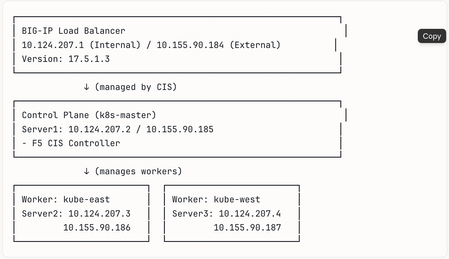
This tutorial simulates orchestrating multiple clusters using a single Kubernetes control plane with separate kubeconfig contexts, the same F5 CIS configuration patterns apply to genuinely separate Kubernetes clusters across different networks, cloud regions, or data centers. The simulation approach allows configuration testing without requiring multiple physical or cloud infrastructure environments.232Views1like0Comments
My Journey to Passing the F5 402 Cloud Solution Specialist Exam: Tips & Guide
## My Journey to Passing the F5 402 Cloud Solution Specialist Exam: Tips & Guide Since study materials and comprehensive guidebooks for the F5 402 Cloud Solution Specialist exam are quite scarce, I wanted to share my personal experience and key takeaways to help those preparing for this certification. ### Prerequisites & Foundational Knowledge * **Mandatory Prerequisites:** You must have already passed the F5 301A+B (LTM) and 302 (GTM/DNS) exams. * **Cloud Background:** A solid understanding of Cloud architecture (at least at a foundational level) is highly recommended. ### Key Exam Topics to Focus On 1. **Deployment Topologies (1 vs. 3 vNICs):** Understand these deployment models thoroughly, especially in Auto Scaling scenarios. Know when to use each, and be aware of their limitations (such as bandwidth constraints). 2. **VE Licensing (Good, Better, Best):** This is heavily tested. Save time by focusing specifically on the modules that differentiate each tier. 3. **Accessing BIG-IP VE on Cloud:** Know the exact procedure for the initial setup—specifically the use of Key-Pairs and Port 8443. 4. **Automation & Templates:** CloudFormation Templates (CFT) and Kubernetes ConfigMaps appear frequently. 5. **Cloud Failover Extension (CFE):** Understand its core concepts, limitations, and practical use cases. 6. **Cloud High Availability (HA) Limitations:** Focus on why standard failover behaviors change in the cloud (e.g., cloud providers not accepting Gratuitous ARP [GARP], or handling multiple Traffic-Groups). 7. **HA Architecture:** Grasp the differences between Active-Standby and Active-Active deployments. 8. **Active-Active with ELB:** Understand why F5 recommends placing cloud-native Load Balancers (like AWS ALB/NLB) in front of an Active-Active F5 cluster. 9. **Cloud-Specific Terminology:** Be comfortable with cloud infrastructure jargon, especially AWS terminology (e.g., Amazon S3, ELB, VPC, AMI, etc.). 10. **AWS vs. Azure Ratio:** The exam leans heavily toward Amazon AWS over Microsoft Azure, roughly an 80:20 split. 11. **F5 Automation Toolchain:** Understand F5 extensions and their distinct use cases, such as iControl LX, iApp LX, and AS3. 12. **Declarative APIs:** Expect many questions regarding API calls used to provision and manage F5 objects. 13. **REST API Fundamentals:** Understand HTTP methods (GET, POST, PUT, PATCH, DELETE) deeply. For instance, know what happens to the configuration state if an API call fails mid-execution. 14. **API Syntax:** Some questions go deep into the exact command syntax. It is vital to look at real-world examples and memorize the syntax structure. 15. **BIG-IQ Integration:** Study the Knowledge Base (KB) articles regarding using BIG-IQ with AS3 as a proxy to create objects on BIG-IP. Pay attention to the initial setup requirements. 16. **Availability Zones (AZ) & Regions:** Understand the conceptual design of multi-AZ and multi-region setups, including their architectural pros and cons. 17. **AWS Auto Scaling Groups (ASG):** This is a major topic. Spend adequate time reading up on how ASG integrates with F5. 18. **Licensing Models (BYOL vs. PAYG):** You won't get straightforward definition questions. Instead, you will need to analyze scenarios to determine which model is the most cost-effective or appropriate. 19. **Traffic Direction Concepts:** Clearly differentiate between North-South (Vertical) and East-West (Horizontal) traffic patterns to analyze scenario-based questions. 20. **Microservices & Containers:** If you aren't familiar with containerization, brush up on it. There will be architectural diagrams involving Pods and NodePorts. 21. **F5 Container Ingress Services (CIS):** This is another heavily tested topic. 22. **Advanced Licensing:** Look into VLS (Volume Licensing Subscription) and CLP (Cloud Licensing Program). 23. **AWS Instance Types:** You don’t need to memorize instance specs by heart. The exam provides reference tables so you can map and choose the most optimal instance type for a given F5 license. 24. **License Bandwidth:** Understand the performance and throughput limits associated with different F5 licenses. 25. **Content Delivery Network (CDN):** Expect diagram-based questions requiring scenario analysis. 26. **F5 Distributed Cloud (XC) & Silverline:** During my attempt, F5 XC wasn't featured yet, but there were some questions regarding Silverline. (Note: This may vary as blueprints update). 27. **Hybrid Cloud Concepts:** Understand the architecture when bridging On-Premises data centers with Public Cloud environments. 28. **Cloud Migration:** Questions will test your analytical skills regarding migrating workloads from On-Prem to the Cloud, specifically around what factors are critical when shifting traffic. 29. **AWS 6 Rs of Migration:** Memorize the concepts (Rehost, Replatform, Refactor, etc.) as they are embedded in multiple situational questions. 30. **Cloud Models & Finance:** Understand the foundational differences between IaaS, PaaS, SaaS, as well as CapEx vs. OpEx. 31. **WILS (The Data Center API Compass Rose):** This framework does make an appearance on the exam. 32. **F5 APM Roles:** Expect a fair share of APM questions where you must identify whether the BIG-IP is acting as the Identity Provider (IdP) or the Service Provider (SP). 33. **Deployment Methods:** Know the nuances of deploying BIG-IP VE via the Cloud Marketplace versus using GitHub Deployment Scripts. 34. **Cloud Bursting & Monitoring:** This is a recurring theme, including how Active Monitors are used to detect load changes and trigger auto-deployments of instances. 35. **Log File Paths:** Know where to look for specific troubleshooting logs, such as iControl errors, authentication failures, and BIG-IQ restjavad logs. 36. **Authentication Protocol Concepts:** Protocols like OAuth and LDAP aren't questioned directly on syntax, but you must understand their architectural diagrams and exchange mechanisms (e.g., Tokens, SAML assertions). 37. **What did NOT appear (in my attempt):** There were no questions regarding AI, GWLB, Transit Gateway (TGW), F5 XC, or advanced Firewall Deployment Modes on Cloud. ### How to Approach F5 Module Review (Levels 3xx vs 4xx) If you already have strong, hands-on experience with F5 modules, you don't necessarily need to re-read all the 3xx-level materials from scratch. The 402 exam looks at them from a higher conceptual level: * **LTM:** Focuses on TMOS architecture, hardware models (like how vCMP operates), and licensing. It won't grill you on basic configurations like "which Load Balancing method to choose." * **GTM/DNS:** Purely conceptual. No deep iQuery troubleshooting, just GSLB terminology and straightforward Static Ratio configurations. * **ASM/AWAF/AFM:** Know which module fits the scenario. For example, choose AFM for L3/L4 DDoS protection, but opt for ASM for L7 DDoS, Behavioral DoS (BaDoS), and WAF capabilities. This ties back into knowing your Better vs. Best license bundles. * **APM:** Highly important. Review the different authentication types and firmly memorize the architectural flow diagrams for IdP and SP. ### Strategy & Exam Tips * **Analytical Focus:** Level 4xx exams test your ability to analyze complex scenarios. Pure theory isn't enough; real-world exposure or architectural thinking is key—especially regarding cloud environments for the 402. * **Time Management is Crucial:** Time is the biggest challenge here. As a non-native English speaker, I was allocated approximately 2 hours and 15 minutes, which felt incredibly tight for the amount of reading required. * **The "Flag" Button is Your Friend:** If you encounter a massive 2-page question with a huge diagram, flag it and skip it immediately. Secure the quick points by answering the shorter questions first. * **Read the Question and Choices First:** For long, diagram-heavy questions, read the actual prompt and the multiple-choice answers before diving into the diagram text. Often, the scenario description contains a lot of fluff ("noise"), and you can actually deduce the correct answer just by reading the options. * **Exam Comparison:** Having gone through the 301B, 401, and 402, I can safely say these exams demand immense mental stamina for analysis. However, 301B felt more exhausting. Once you "catch the rhythm" of the 4xx questions, it becomes manageable. * **Question Pool Size:** I took both the 401 and 402 twice before passing. I felt that the 402 had a much larger question pool. On my second attempt at the 402, I encountered a significant amount of brand-new questions, whereas the 401 retake had quite a lot of repeats. Best of luck to everyone preparing for the F5 402! I hope you get questions that align with your preparation. Use this guide as a reference point for your studies, and feel free to share your thoughts!157Views3likes1Comment